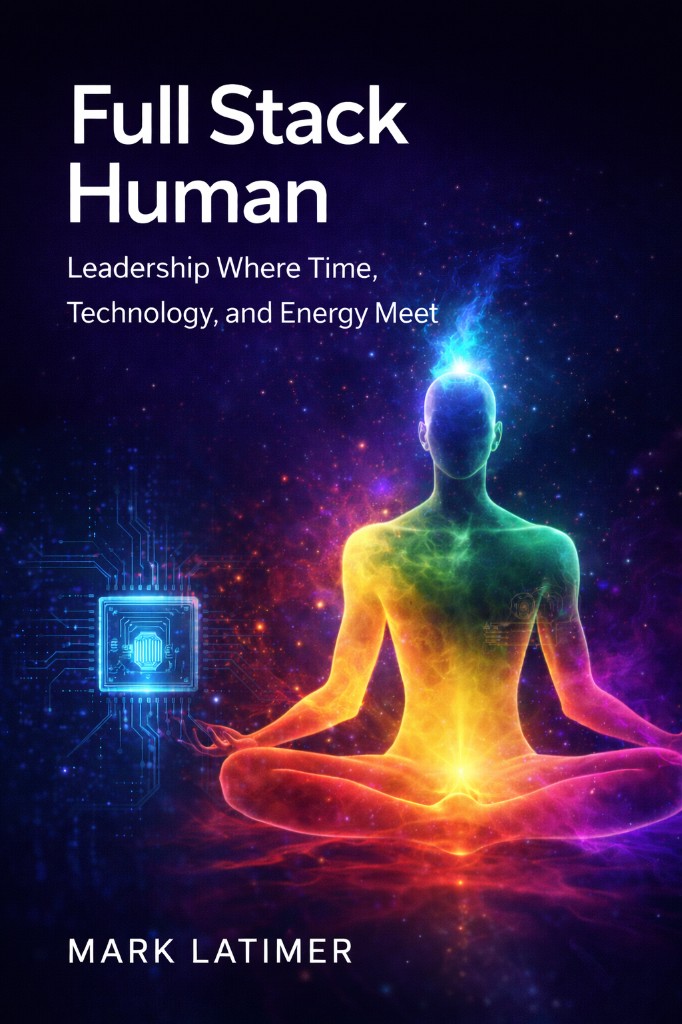
Full Stack Human book cover

CalnFlow Library

Full Stack Human

Leadership Where Time, Technology, and Energy Meet

Author and systems architect

Creator of Coachable Cards and CalnFlow Reader.

→ More from Mark

CalnFlow Library

Full Stack Human

Leadership Where Time, Technology, and Energy Meet

Leadership succeeds when time, technology, and energy are designed as one system.

Author: Mark Latimer · 108 pages · 36 chapters
Back to library

Introduction: Leadership Where Time, Technology, and Energy Meet

0:000:00

Leadership is no longer a role. It is a full stack responsibility.

A leader today must navigate time pressure, technological acceleration, and human energy, all at once. The systems are faster. The expectations are higher. The teams are more distributed. The decisions carry more weight.

In this world, technical competence is necessary but not sufficient. Leaders must understand the human stack: the layers of trust, energy, culture, and emotion that determine whether a team moves together or fractures under pressure.

Full Stack Human is a leadership book for this moment. It does not reject technology. It completes it. It asks what kind of human system can sustain modern velocity without losing meaning.

This book is not about soft skills. It is about infrastructure. The human stack is the infrastructure of leadership. If it is stable, technology amplifies it. If it is fragile, technology exposes it.

This is why this book matters now.

The structure follows three movements:

  • Part I: The Human Stack. The layers leaders must learn to see.
  • Part II: The Practice. The daily rituals that build trust and energy.
  • Part III: The Future. What leadership becomes in an accelerated world.

This book is for leaders who carry responsibility for people, not just for outcomes. It is for founders, executives, and builders who want to lead with clarity, steadiness, and integrity in a world that rewards speed.

Full Stack Human is the third pillar of the CalnFlow leadership platform:

  • Time is leadership.
  • Security is culture.
  • Human systems are the foundation.

Together, they form a complete leadership architecture.

This book also respects the reality of global leadership. In India and across enterprise culture, leadership is not merely performance. It is trust. It is steadiness. It is the ability to hold tension without losing respect. The practices here are designed for that reality.

You do not need to become a different person. You need a clearer system for the person you already are.

If you are ready to lead across time, technology, and energy, this is your field guide.

Let us begin.

Chapter 1

1. Full Stack Leader

0:000:00

A full stack leader sees the whole system, not just the surface.

In technology, a full stack engineer understands layers from infrastructure to interface. In leadership, the same principle applies: the leader must understand the layers that turn intention into experience.

These layers include:

  • Time: the cadence of execution.
  • Technology: the tools that shape behavior.
  • Energy: the human capacity that powers the system.
  • Culture: the shared norms that guide decisions.
  • Trust: the invisible infrastructure of collaboration.

If any layer breaks, the system breaks.

Most leaders optimize one layer. The full stack leader holds all layers with balance.

Full stack leadership is systems work. The core question is not: "How do I lead better?" The core question is: "What system am I creating for others to lead well?"

When leaders see the whole stack, they locate the failing layer and respond with precision. If morale drops, they check trust. If execution slows, they check time. If teams resist change, they check culture.

The full stack leader is a system designer.

Chapter 2

2. Invisible Layers

0:000:00

Most leadership failures are invisible at first.

The visible layer is performance: missed deadlines, uneven results, disengagement. Those are symptoms. The causes sit underneath.

The invisible layers are:

  • Trust: the willingness to be open without fear.
  • Psychological safety: the freedom to speak and be wrong.
  • Energy: the capacity to sustain attention and care.
  • Clarity: the shared understanding of what matters.

These layers are structural. When they erode, the system slows down.

When trust is high, decisions move faster. When trust is low, everything requires approval. Trust is built in small moments: follow-through, clear communication, respect for time. It is lost in small breaches: delays, ambiguity, avoidance.

Teams move faster when they can speak honestly. Psychological safety is clarity, not comfort. Silence is cost.

Energy predicts performance. When energy is depleted, outcomes decline. When energy is stable, outcomes compound. Energy is managed by rhythm, rest, and clarity.

The invisible layers are the leader's responsibility. You cannot delegate the foundation of culture. You can only model it.

This is the core of full stack leadership: design the conditions that make teams resilient, not just productive.

Chapter 3

3. Time, Tech, and Energy

0:000:00

Time, technology, and energy are the three forces that shape modern leadership.

Time is the frame. Technology is the amplifier. Energy is the fuel.

When these three are aligned, leadership feels calm and effective. When they are not, leadership feels chaotic and exhausting.

Time is the constraint that makes leadership real. Without a clear time frame, strategy becomes theory. The calendar is where leadership becomes visible. Leaders must treat time as a design element. The schedule creates focus.

Technology amplifies whatever culture you already have. If culture is strong, technology scales it. If culture is fragile, technology exposes it. Leaders must ask: "What behavior does this tool reward?" The answer determines whether technology becomes an ally or a drain.

Energy is the hidden clock. It determines how much of the time frame is usable. You can have plenty of time but little energy—that creates stagnation. You can have limited time and high energy—that creates momentum. Energy is a systems issue, shaped by clarity, boundaries, and rhythm.

The alignment principle:

  • Time creates the structure.
  • Technology creates the scale.
  • Energy creates the sustainability.

If you align these three, leadership becomes steady. If you neglect one, the system wobbles.

This is the core of the full stack human model.

Chapter 4

4. Emotional Operating System

0:000:00

Leaders operate an emotional operating system. Most do not realize it.

The emotional operating system processes feelings, reactions, and responses. It determines how leaders handle pressure, conflict, and uncertainty. It shapes how teams experience leadership.

Most leaders ignore this system. They treat emotions as distractions, not as infrastructure.

But emotions are infrastructure. They determine how decisions are made, how teams respond, how leadership feels.

The emotional operating system is always running. It processes every interaction, shapes every decision, influences every outcome.

When this system is stable, leadership feels calm. When unstable, leadership feels chaotic. The difference is emotional infrastructure, not strategy.

The emotional system processes information differently than the rational system. It responds faster, reacts more strongly, influences decisions before reason can intervene.

This is not a weakness. It is a feature. The emotional system provides rapid assessment, signals what matters, guides attention.

When unmanaged, it amplifies threats, creates reactivity, fragments focus.

The emotional operating system requires regulation: boundaries, structure, intentional design.

Regulation is management: recognizing emotions without being controlled by them, using emotions as information, not commands.

Leaders who understand their emotional operating system process pressure without panic, handle conflict without reactivity, navigate uncertainty without anxiety.

The leader's emotional operating system affects the team. When leaders are emotionally stable, teams are stable. When reactive, teams are reactive.

Designing the emotional operating system requires:

  • Awareness: Recognize emotional patterns and triggers.
  • Regulation: Manage emotional responses intentionally.
  • Integration: Use emotions as information in decision-making.

The emotional operating system is part of the full stack. It works with time, technology, and energy.

When leaders design their emotional operating system, they create stability, clarity, advantage.

Chapter 5

5. Psychological Safety

0:000:00

Psychological safety is not comfort. It is clarity.

Most leaders misunderstand psychological safety. They think it means avoiding conflict or reducing pressure.

But psychological safety is freedom: the freedom to speak honestly, to be wrong, to challenge assumptions without fear of retribution.

This freedom is essential for high performance. Teams with psychological safety move faster, surface problems earlier, make better decisions.

Psychological safety is clarity about boundaries. It is knowing what you can say and what you cannot say, what is acceptable and what is not.

When boundaries are clear, people operate freely within them. When boundaries are unclear, people operate cautiously, avoid risk, avoid honesty.

Clarity creates safety. Ambiguity creates fear.

Psychological safety is strategic. Teams with psychological safety perform better because they speak honestly about problems.

When problems are hidden, they become expensive. When problems are surfaced early, they can be solved quickly.

Leaders create psychological safety. They set boundaries, model behavior, respond to honesty.

This responsibility cannot be delegated. Leaders must create conditions that allow honesty, respond to problems without blame, reward candor, not punish it.

Leaders create psychological safety through response patterns. How leaders respond to problems determines whether people will surface problems in the future.

When leaders respond with blame, people hide problems. When leaders respond with curiosity, people surface problems.

The response pattern creates learning. When problems are learning opportunities, people share them. When problems are blame opportunities, people hide them.

Psychological safety becomes team culture. When leaders model safety, teams adopt safety. When leaders model fear, teams adopt fear.

Leaders who create psychological safety get information earlier, solve problems faster, make better decisions.

Psychological safety creates effectiveness through honesty, not comfort.

Chapter 6

6. Trust as Infrastructure

0:000:00

Trust is not a feeling. It is infrastructure.

Trust determines how fast decisions move, how much coordination costs, how well teams perform.

When trust is high, everything moves faster. When trust is low, everything requires approval. The difference is infrastructure, not strategy.

Trust enables everything else: delegation, autonomy, speed.

When trust is present, leaders delegate without micromanaging. Teams operate without constant approval. Decisions move without extensive verification.

When trust is absent, everything requires control: constant verification, extensive approval processes, redundant controls.

These costs slow everything down, reduce effectiveness, create frustration.

Trust is built through behavior, not words; through consistency, not promises; through action, not intention.

The building process has three parts:

  • Reliability: Do what you say you will do.
  • Competence: Do what you say you will do well.
  • Care: Show that you care about outcomes and people.

When these three parts are present, trust builds. When absent, trust erodes.

Trust requires maintenance through consistent behavior.

When behavior is inconsistent, trust erodes. When consistent, trust compounds.

Leaders model trust. When leaders trust their teams, teams trust their leaders. When leaders micromanage, teams become dependent.

Leaders must model the trust they want to see: demonstrate reliability, competence, care; maintain trust through consistent behavior.

When trust is infrastructure, the system works better. Decisions move faster. Teams operate more effectively. Performance improves.

Trust creates effectiveness through speed, not comfort.

Chapter 7

7. Culture Is Code

0:000:00

Culture is not decoration. It is code.

Culture determines how decisions are made, how problems are solved, how teams operate.

Culture is the operating system of the organization. It runs in the background, shapes everything, determines outcomes.

Culture programs behavior. It creates patterns, establishes defaults, shapes responses.

When culture is strong, behavior is predictable. When culture is weak, behavior is inconsistent. The difference is code, not people.

Culture is what people actually do, not what they say they do.

Culture programs behavior through signals. It signals what is rewarded and what is punished, what is acceptable and what is not.

These signals are often implicit: in how leaders respond, how systems work, how teams operate.

Leaders design culture by designing signals. They program behavior by programming responses.

Culture creates default settings. It determines how people respond when uncertain, what happens when there is no explicit instruction.

These default settings shape behavior automatically, create patterns without intention.

When default settings are aligned with mission, teams move in the right direction. When misaligned, teams drift.

Leaders write culture code through behavior. Every action is a signal. Every response is a program. Every decision is code.

Consistent behavior creates consistent culture. Inconsistent behavior creates inconsistent culture.

Leaders must write code intentionally: design signals deliberately, program behavior consciously.

Culture is system design: creating structures that produce the right behavior, designing signals that create the right responses.

Patterns are more powerful than policies. Policies are explicit. Patterns are implicit.

Culture creates performance. When culture is strong, performance is strong. When culture is weak, performance is weak.

Leaders are responsible for culture code. They write it through behavior, program it through signals, design it through systems.

This responsibility cannot be delegated. Leaders must write code intentionally, program behavior deliberately, design culture consciously.

Intentional code creates intentional culture.

Chapter 8

8. Rituals Build Teams

0:000:00

Rituals build teams. Not events. Not programs. Rituals.

Most leaders confuse rituals with events. They think team building is about offsites or activities.

But rituals are repeated patterns: consistent practices, regular rhythms.

Rituals build teams because they create shared experience, common language, collective memory.

Rituals are different from events because they repeat. Events happen once. Rituals happen regularly. This repetition creates power.

When rituals repeat, they become part of the team's identity. They create patterns teams recognize, build memory teams share.

Rituals create shared experience. When teams participate in rituals together, they create common memory, collective identity.

This shared experience creates connection, belonging, team.

When rituals repeat, the experience compounds.

Rituals create common language: terms teams understand, references teams share.

This common language enables communication, coordination, culture.

Rituals create collective memory: stories teams tell, history teams remember.

This collective memory creates continuity, identity, team.

Designing rituals requires intention. Leaders must choose what to repeat, decide what patterns to create.

The design practice has three parts:

  • Choose the ritual: What pattern will you repeat?
  • Establish the rhythm: How often will it happen?
  • Maintain the practice: How will you keep it going?

Rituals require maintenance, commitment.

Leaders model rituals. When leaders participate in rituals, teams participate. When leaders skip rituals, teams skip.

Consistent participation creates consistent ritual.

Leaders must model the rituals they want to see: participate consistently, maintain the practice.

When rituals are part of the system, teams are stronger. They have shared experience, common language, collective memory.

Rituals create function through repetition, not entertainment.

Chapter 9

9. The Cost of Burnout

0:000:00

Burnout has a cost. Most leaders do not calculate it.

The cost is organizational. When people burn out, teams lose capacity. When teams lose capacity, organizations lose performance.

Burnout is not about working hard. It is about working without recovery: depletion without renewal, exhaustion without restoration.

Burnout is depletion: the exhaustion of energy, attention, care. It is the depletion of capacity to perform.

When people are depleted, they cannot perform, think clearly, make good decisions, sustain effort.

People have finite capacity. When capacity is depleted, performance declines.

Recovery is required. People cannot sustain performance without recovery, maintain capacity without renewal.

Most leaders ignore recovery. They focus on output, not capacity; optimize for utilization, not sustainability.

But recovery is essential. Without recovery, capacity depletes. Without renewal, performance declines.

The cost of burnout includes lost capacity, reduced performance, increased turnover. These costs are measurable but often ignored.

When people burn out, they leave. When people leave, teams lose knowledge. When teams lose knowledge, organizations lose capability.

Preventing burnout requires design: creating systems that support recovery, building rhythms that allow renewal.

The prevention design has three parts:

  • Rhythm: Create cadence that includes recovery.
  • Boundaries: Set limits that protect capacity.
  • Support: Provide resources that enable renewal.

Leaders are responsible for preventing burnout. They create systems that determine capacity, design rhythms that allow recovery.

Designing systems that prevent burnout requires intention: create rhythms that include recovery, set boundaries that protect capacity.

The system design is designing work sustainably, creating capacity that can be maintained.

Leaders who prevent burnout maintain capacity, sustain performance, retain talent.

Burnout prevention is performance optimization.

Chapter 10

10. Leading in Uncertainty

0:000:00

Uncertainty is the condition of leadership. Most leaders try to eliminate it.

They create plans, build forecasts, develop strategies. They try to reduce uncertainty to zero.

But uncertainty cannot be eliminated. It can only be navigated. Leaders who try to eliminate uncertainty create rigidity. Leaders who navigate uncertainty create resilience.

Uncertainty is reality. The future is unknown. Plans will change. Forecasts will be wrong. Strategies will need adjustment.

Leaders must operate in uncertainty, not despite it.

Navigating uncertainty requires skill: the ability to operate without complete information, the capacity to adjust as conditions change.

Most leaders are not trained in navigation. They are trained in planning. They know how to create plans, but not how to navigate when plans change.

Navigating uncertainty requires clarity. Not clarity about the future, but clarity about the present. Not clarity about outcomes, but clarity about direction.

When leaders have clarity about direction, they can navigate uncertainty. When leaders lack clarity, uncertainty becomes chaos.

The clarity requirement is knowing what matters. It is having a compass, not a map.

Navigating uncertainty requires adaptation capacity. Leaders must adjust as conditions change, pivot when plans fail.

This capacity is responsiveness. It is having systems that can adapt, not systems that are rigid.

Navigating uncertainty requires a leadership posture. Leaders must accept uncertainty without anxiety, operate in uncertainty without panic.

This posture is clarity. When leaders are clear about direction, uncertainty becomes manageable.

The leader's relationship with uncertainty affects the team. When leaders panic in uncertainty, teams panic. When leaders navigate uncertainty, teams navigate.

The leader's posture shapes the team's posture. The leader's capacity shapes the team's capacity.

Designing systems for uncertainty requires building for adaptation, not stability; creating flexibility, not rigidity.

Leaders who navigate uncertainty operate effectively in changing conditions, adapt when plans fail, lead in reality, not theory.

Uncertainty requires adaptation. Leaders who adapt lead effectively.

Chapter 11

11. Presence as Power

0:000:00

Presence is power. Most leaders do not realize it.

Presence is attention: being fully present in the moment, fully engaged with what is happening.

When leaders are present, they see clearly, hear accurately, respond appropriately, lead effectively.

When leaders are absent, they miss signals, misunderstand situations, respond inappropriately, lead poorly.

Presence is the capacity to focus fully on what is happening now, not on what happened before or what might happen next.

Most leaders are not present. They are thinking about the next meeting, the next decision, the next problem. They are physically present but mentally absent.

This absence is expensive: misunderstandings, missed opportunities, poor decisions.

Presence creates clarity. When leaders are present, they see what is actually happening, understand what is actually being said, perceive what is actually needed.

This clarity enables better decisions, better responses, better leadership.

Presence enables listening. When leaders are present, they listen fully. They hear what is being said and what is not being said.

Most leaders do not listen. They are thinking about their response, preparing their answer, planning their next move.

This listening failure is expensive: misunderstandings, missed information, poor relationships.

Presence improves response quality. When leaders are present, they respond appropriately. They address what is actually happening, not what they think is happening.

The leader's presence affects the team. When leaders are present, teams feel seen. When leaders are absent, teams feel ignored.

Teams perform better when leaders are present. Teams perform worse when leaders are absent.

Presence requires practice. It is not automatic. It requires intentional attention, deliberate focus.

Presence is a skill that must be developed, not assumed.

Leaders who are present see clearly, hear accurately, respond appropriately, lead effectively.

Presence creates power through attention, not position.

Chapter 12

12. The Leadership Thesis

0:000:00

The leadership thesis: Leadership succeeds when time, technology, and energy are designed as one system.

This is not a management framework. It is a leadership system. It is not about optimizing parts. It is about designing the whole.

The thesis has three parts:

  • Time: The frame that creates structure.
  • Technology: The amplifier that creates scale.
  • Energy: The fuel that creates sustainability.

These three parts work together. Time creates structure. Technology creates scale. Energy creates sustainability.

Time is the foundation. Leadership happens in time. Decisions are made in time. Teams operate in time.

Most leaders treat time as a constraint. They try to manage it, optimize it, control it.

But time is not a constraint to manage. It is a frame to design. When leaders design time well, leadership works. When leaders design time poorly, leadership fails.

Technology is the amplifier. It amplifies whatever culture you already have. If culture is strong, technology scales it. If culture is fragile, technology exposes it.

Most leaders treat technology as a tool. They try to use it, implement it, adopt it.

But technology is not a tool to use. It is an amplifier to design. When leaders design technology well, it amplifies strength. When leaders design technology poorly, it amplifies weakness.

Energy is the fuel. It determines how much of the time frame is usable, how well technology can amplify, how effectively leadership operates.

Most leaders ignore energy. They focus on output, not capacity; optimize for utilization, not sustainability.

But energy is essential. When energy is present, everything works. When energy is absent, nothing works.

Together, time, technology, and energy form a system. This system is not a collection of parts. It is an integrated whole.

When the system is designed well, leadership works. When the system is designed poorly, leadership fails.

The system design is integration, not coordination.

This system creates a leadership advantage. Not because it is complex, but because it is clear. Not because it is new, but because it is complete.

Leaders who design the full stack create structure through time, scale through technology, sustainability through energy.

Part I is complete. You have seen the human stack. You understand the layers, how they work together.

Part II is next. You will see the practice: daily rituals, weekly rhythms, how to build the full stack.

But understanding the stack comes first. Without understanding the layers, the practice makes no sense.

You understand the stack. Now you are ready for the practice.

That is the leadership thesis. That is the path to full stack human leadership.

Chapter 13

13. Daily Reset

0:000:00

The daily reset is not a luxury. It is a requirement.

Most leaders start their days reactively: checking email, responding to messages, jumping into meetings. They begin in reaction, not intention.

The daily reset creates intention. It establishes clarity. It sets the foundation for the day.

The daily reset clarifies what matters today, establishes priorities, sets boundaries.

When you reset daily, you begin with clarity. When you do not reset, you begin with reaction.

Clarity creates effectiveness. Reaction creates exhaustion.

The daily reset answers what matters today, establishes what gets attention, defines what gets protected.

This clarity creation is clarifying priorities, not planning everything.

The daily reset sets boundaries: defines what gets time, establishes what gets attention, creates limits that protect focus.

When boundaries are set, the day has structure.

The daily reset creates an energy foundation: establishes the energy level, sets the emotional tone, creates the capacity for the day.

When energy foundation is set, the day has capacity.

The energy foundation is design.

Practice the daily reset: create intention, establish clarity, set boundaries, design energy.

The daily reset creates the foundation for effective leadership.

Chapter 14

14. Weekly Circle

0:000:00

The weekly circle creates connection. It builds trust. It restores energy.

Most teams operate in isolation: working independently, communicating transactionally, connecting rarely.

But the weekly circle creates connection, builds trust, restores energy.

The weekly circle brings people together, builds relationships, creates belonging.

When teams circle weekly, they connect regularly.

The circle purpose is connection, not meetings. Connection creates trust. Isolation creates fragmentation.

The weekly circle builds trust: creates space for honesty, enables vulnerability, builds relationships.

When trust is built, teams work better.

The trust building is creating safety, not sharing everything.

The weekly circle restores energy: creates renewal, builds capacity, restores focus.

When energy is restored, teams have capacity.

The energy restoration is renewal, not entertainment.

The connection creation is intentional connection, not forced interaction.

Practice the weekly circle: create connection, build trust, restore energy.

This practice is essential. The weekly circle creates the foundation for effective teams.

Chapter 15

15. One Question Meeting

0:000:00

The one question meeting creates clarity. It eliminates waste. It enables decisions.

Most meetings have too many questions. They discuss everything, decide nothing, consume time without creating value.

But the one question meeting focuses on one question. It creates clarity. It enables decisions.

The one question meeting eliminates distraction, creates clarity, enables decisions.

When meetings focus on one question, they create value. When meetings focus on many questions, they create waste.

The question focus is clarity, not limiting discussion. When clarity exists, decisions are easy. When clarity does not exist, decisions are difficult.

The one question meeting answers the question, establishes understanding, enables decisions.

This clarity creation is focusing complexity, not avoiding it. When complexity is focused, it becomes manageable. When complexity is unfocused, it becomes overwhelming.

The one question meeting enables decisions: creates clarity that enables choice, establishes understanding that enables action.

When decisions are enabled, meetings create value. When decisions are not enabled, meetings create waste.

The decision enablement is creating clarity, not forcing decisions.

Practice the one question meeting: focus on one question, create clarity, enable decisions.

The one question meeting creates value through focus.

Chapter 16

16. Coaching as Leadership

0:000:00

Coaching is not a role. It is leadership.

Most leaders think coaching is separate from leadership. They delegate coaching, outsource development, separate coaching from leading.

But coaching is leadership. It is how leaders develop people, build capacity, create leverage.

When leaders coach, they develop people. When leaders do not coach, they manage tasks.

Coaching develops people: builds capacity, creates growth, enables performance.

When people are developed, they perform better. When people are not developed, they perform worse.

The development function is building capacity, not fixing problems. When capacity is built, performance improves. When capacity is not built, performance stagnates.

Coaching builds capacity: develops skills, builds confidence, creates capability.

When capacity is built, people can do more. When capacity is not built, people can do less.

The capacity building is development, not training. When people are developed, capacity grows. When people are trained, capacity is transferred.

Coaching creates leverage: multiplies effectiveness, builds systems, creates scale.

When coaching creates leverage, leadership multiplies. When coaching does not create leverage, leadership adds.

The leverage creation is developing more, not doing more.

Practice coaching as leadership: develop people, build capacity, create leverage.

Coaching is leadership.

Chapter 17

17. The Feedback Gift

0:000:00

Feedback is not criticism. It is a gift.

Most leaders avoid feedback. They fear conflict, avoid difficult conversations, postpone feedback.

But feedback is a gift. It creates growth, builds capacity, enables improvement.

Feedback creates growth: provides information, enables improvement, builds capacity.

When feedback is given as a gift, it creates value. When feedback is given as criticism, it creates defensiveness.

The gift model is framing feedback as growth, not avoiding difficult feedback. When feedback is framed as growth, it creates value. When feedback is framed as criticism, it creates defensiveness.

Feedback provides information: clarifies expectations, identifies gaps, enables improvement.

When information is provided, people can improve. When information is not provided, people cannot improve.

The information provision is clarity, not niceness. When feedback is clear, it creates value. When feedback is unclear, it creates confusion.

Feedback builds capacity: develops skills, builds confidence, creates capability.

When capacity is built, people can do more. When capacity is not built, people can do less.

The capacity building is providing constructive feedback, not avoiding difficult feedback.

Practice feedback as gift: provide information, create growth, build capacity.

Feedback is a gift.

Chapter 18

18. Story as Strategy

0:000:00

Story is not decoration. It is strategy.

Most leaders think story is for marketing. They separate story from strategy, treat story as communication, not leadership.

But story is strategy. It shapes culture, creates alignment, enables execution.

Story shapes culture: defines values, creates norms, establishes expectations.

When culture is shaped by story, it is clear. When culture is not shaped by story, it is unclear.

The culture shaping is living stories, not telling stories. When stories are lived, culture is shaped. When stories are told, culture is not shaped.

Story creates alignment: clarifies direction, establishes purpose, enables coordination.

When alignment is created, teams work together. When alignment is not created, teams work separately.

The alignment creation is aligning people, not inspiring people. When people are aligned, they work together. When people are inspired, they may not work together.

Story enables execution: clarifies what to do, establishes how to do it, creates why to do it.

When execution is enabled, strategy works. When execution is not enabled, strategy fails.

The execution enablement is clarity, not motivation. When clarity exists, execution is enabled. When clarity does not exist, execution is not enabled.

Practice story as strategy: shape culture, create alignment, enable execution.

Story is strategy.

Chapter 19

19. Courageous Conversations

0:000:00

Courageous conversations are not optional. They are essential.

Most leaders avoid difficult conversations. They postpone conflict, avoid tension, hope problems resolve themselves.

But courageous conversations resolve problems, build trust, create clarity.

Courageous conversations address issues, create clarity.

When conversations are courageous, problems are resolved. When conversations are avoided, problems persist.

The essential nature is addressing issues, not seeking conflict.

Courageous conversations resolve problems: address issues, create clarity, enable solutions.

When problems are resolved, teams work better. When problems are not resolved, teams work worse.

The problem resolution is solving problems, not winning arguments.

Courageous conversations build trust: create honesty, enable vulnerability, build relationships.

When trust is built, teams work better. When trust is not built, teams work worse.

The trust building is addressing conflict constructively, not avoiding conflict.

Courageous conversations create clarity: address issues, establish understanding, enable solutions.

When clarity is created, teams work better. When clarity is not created, teams work worse.

The clarity creation is directness, not aggressiveness.

Practice courageous conversations: resolve problems, build trust, create clarity.

Courageous conversations are essential.

Chapter 20

20. Energy Mapping

0:000:00

Energy mapping creates awareness. It enables design. It builds capacity.

Most leaders ignore energy. They focus on tasks, optimize for output, ignore capacity.

But energy mapping creates awareness, enables design, builds capacity.

Energy mapping shows where energy goes, identifies energy drains, reveals energy sources.

When awareness is created, energy can be managed. When awareness is not created, energy cannot be managed.

The awareness creation is understanding patterns, not tracking everything.

Energy mapping enables design: shows how to design for energy, identifies what drains energy, reveals what restores energy.

When design is enabled, energy can be optimized. When design is not enabled, energy cannot be optimized.

The design enablement is designing for balance, not eliminating all drains.

Energy mapping builds capacity: shows how to increase capacity, identifies what creates capacity, reveals what depletes capacity.

When capacity is built, more is possible. When capacity is not built, less is possible.

The capacity building is working smarter, not working more.

Practice energy mapping: create awareness, enable design, build capacity.

Energy mapping creates the foundation for sustainable leadership.

Chapter 21

21. The Calm Leader

0:000:00

The calm leader is not passive. They are clear.

Most leaders confuse calm with passivity. They think calm means slow, assume calm means weak.

But the calm leader is clear, decisive, effective.

The calm leader has clarity: knows what matters, understands priorities, sees clearly.

When clarity exists, calm is possible. When clarity does not exist, calm is not possible.

The clarity foundation is making clear decisions, not avoiding decisions.

The calm leader acts decisively: makes decisions, takes action, moves forward.

When action is decisive, calm is maintained. When action is indecisive, calm is lost.

The decisive action is clarity, not rushing.

The calm leader operates effectively: creates value, builds systems, enables teams.

When operation is effective, calm is maintained. When operation is ineffective, calm is lost.

The effective operation is solving problems, not avoiding problems.

The calm leader models calm: creates stability, builds trust, enables performance.

When calm is modeled, teams are calm. When calm is not modeled, teams are not calm.

The leadership model is managing emotion, not avoiding emotion.

Practice being the calm leader: create clarity, act decisively, operate effectively.

The calm leader creates the foundation for effective leadership.

Chapter 22

22. Designing for Belonging

0:000:00

Belonging is not optional. It is essential.

Most leaders ignore belonging. They focus on performance, optimize for output, ignore connection.

But belonging creates engagement, builds commitment, enables performance.

When belonging exists, people engage. When belonging does not exist, people disengage.

The essential nature is creating connection, not being nice.

Belonging creates engagement, builds commitment, enables performance.

When engagement is created, people perform better. When engagement is not created, people perform worse.

The engagement creation is creating connection, not avoiding conflict.

Belonging builds commitment: creates loyalty, enables retention.

When commitment is built, people stay. When commitment is not built, people leave.

The commitment building is creating connection, not avoiding difficult conversations.

Belonging enables performance: creates engagement, builds commitment, enables results.

When performance is enabled, results are created. When performance is not enabled, results are not created.

The performance enablement is creating connection, not avoiding standards.

Practice designing for belonging: create connection, build engagement, enable performance.

Belonging is essential.

Chapter 23

23. First Small Ritual

0:000:00

The first small ritual matters. It creates the foundation, establishes the pattern, begins the practice.

Most leaders wait for perfect conditions. They postpone rituals, delay practice, hope for better timing.

But the first small ritual begins now. It creates the foundation, establishes the pattern.

When the foundation is created, practice can grow. When the foundation is not created, practice cannot grow.

The foundation creation is beginning, not perfection.

The first small ritual establishes the pattern: creates the sequence, begins the practice.

When the pattern is established, practice can continue. When the pattern is not established, practice cannot continue.

The pattern establishment is beginning, not complexity.

The first small ritual begins the practice: creates the habit, establishes the rhythm.

When practice begins, it can grow. When practice does not begin, it cannot grow.

The practice beginning is starting, not perfection.

The first small ritual creates momentum: proves practice is possible, demonstrates progress is achievable.

When momentum is created, practice continues. When momentum is not created, practice stops.

The momentum creation is small starts, not big wins.

Practice the first small ritual: create the foundation, establish the pattern, begin the practice.

The first small ritual creates the foundation for effective leadership.

Chapter 24

24. Team Reset

0:000:00

The team reset restores alignment. It rebuilds trust. It renews energy.

Most teams operate without reset. They continue without pause, work without renewal, operate without alignment.

But the team reset restores alignment, rebuilds trust, renews energy.

The team reset clarifies direction, establishes priorities, creates focus.

When alignment is restored, teams work together. When alignment is not restored, teams work separately.

The alignment restoration is creating clarity, not forcing agreement.

The team reset rebuilds trust: creates space for honesty, enables vulnerability, builds relationships.

When trust is rebuilt, teams work better. When trust is not rebuilt, teams work worse.

The trust rebuilding is addressing issues, not avoiding conflict.

The team reset renews energy: creates restoration, builds capacity, restores focus.

When energy is renewed, teams have capacity. When energy is not renewed, teams deplete capacity.

The energy renewal is restoration, not entertainment.

The team reset creates focus: clarifies priorities, establishes boundaries, enables execution.

When focus is created, teams execute better. When focus is not created, teams execute worse.

The focus creation is creating clarity, not limiting discussion.

Practice the team reset: restore alignment, rebuild trust, renew energy.

The team reset creates the foundation for effective teams.

Chapter 25

25. The India Leadership Moment

0:000:00

India is having a leadership moment. It is not just growing. It is leading.

India requires different models, different infrastructure, different leadership.

India is having a leadership moment because it is large, growing, digital. It needs leadership that works.

This moment reality is need, not market size.

India requires models that respect culture, work with infrastructure, serve people.

This model requirement is creating Indian models, not adapting Western models.

India requires infrastructure respect: systems that work with existing infrastructure, models that do not require new infrastructure.

This infrastructure respect is respecting infrastructure, not avoiding it.

India requires cultural alignment: systems that respect culture, models that work with culture.

This cultural alignment is aligning with culture, not avoiding it.

Leaders must understand India as moment. India is not just a market. It is a leadership moment.

The understanding is creation, not adaptation. India requires new models, new approaches, new leadership.

Chapter 26

26. Global Teams, Human First

0:000:00

Global teams require human-first leadership. They cannot be managed like local teams. They require different approaches.

Most leaders manage global teams like local teams. They assume same time zones, expect same culture, require same behavior.

But global teams require human-first leadership, cultural respect, time zone awareness.

Global teams require human-first leadership because they are human: different cultures, different time zones, different needs.

This human-first requirement is respecting humanity, not avoiding structure.

Global teams require cultural respect: leaders who understand culture, systems that respect culture.

This cultural respect is respecting culture, not avoiding it.

Global teams require time zone awareness: leaders who understand time zones, systems that respect time zones.

This time zone awareness is respecting time zones, not avoiding them.

Global teams require communication design: systems that enable communication, processes that respect time zones.

This communication design is designing communication, not avoiding it.

Leaders must understand global teams as human-first. Global teams are not local teams. They require different leadership.

The understanding is creation, not adaptation. Global teams require new models, new approaches, new leadership.

Chapter 27

27. AI and the Human Edge

0:000:00

AI amplifies the human edge. It does not replace it. It enhances it.

Most leaders fear AI. They assume it replaces humans, expect it eliminates jobs, require resistance.

But AI amplifies the human edge: enhances human capability, multiplies human effectiveness, creates human advantage.

The human edge is real. Humans have capabilities AI does not have: judgment, empathy.

This edge reality is using AI, not avoiding it. When AI amplifies the human edge, advantage is created. When AI replaces the human edge, advantage is lost.

AI amplifies the human edge by enhancing capability, multiplying effectiveness, creating advantage.

This amplification model is using AI, not avoiding it.

AI enhances human capability. When capability is enhanced, advantage is created. When capability is not enhanced, advantage is not created.

AI does not replace human judgment. It amplifies it, enhances it, creates advantage.

When judgment is preserved, advantage is created. When judgment is not preserved, advantage is lost.

The judgment preservation is using AI, not avoiding it.

Leaders must understand AI as amplifier. AI does not replace humans. It amplifies them.

The understanding is opportunity, not fear. AI creates opportunity. Leaders must use it.

Chapter 28

28. The Ethics of Speed

0:000:00

Speed has ethics. It is not neutral. It has consequences.

Most leaders treat speed as neutral. They assume faster is better, require acceleration, ignore consequences.

But speed has ethics: affects people, impacts systems, creates consequences.

Speed creates consequences: affects people, impacts systems, creates outcomes.

When consequences are considered, speed is ethical. When consequences are not considered, speed is not ethical.

Speed impacts people: affects energy, impacts capacity, creates stress.

When people impact is considered, speed is ethical. When people impact is not considered, speed is not ethical.

Speed affects systems: impacts stability, creates fragility, requires balance.

When system consideration exists, speed is ethical. When system consideration does not exist, speed is not ethical.

Leaders must understand speed as ethical. Speed is not neutral. It has consequences.

The understanding is understanding speed, not avoiding it.

Chapter 29

29. Leading Through Change

0:000:00

Leading through change requires stability. It requires clarity. It requires trust.

Most leaders lead change by creating more change: adding complexity, increasing uncertainty, creating instability.

But leading through change requires stability, clarity, trust.

Leading through change requires stability: a stable foundation, clear direction, trusted leadership.

When stability exists, change is possible. When stability does not exist, change is not possible.

The stability requirement is enabling change, not avoiding it.

Leading through change requires clarity: clear direction, clear priorities, clear communication.

When clarity exists, change is possible. When clarity does not exist, change is not possible.

The clarity creation is enabling change, not avoiding it.

Leading through change requires trust: trusted leadership, trusted systems, trusted processes.

When trust exists, change is possible. When trust does not exist, change is not possible.

The trust building is enabling change, not avoiding it.

Leading through change enables change: creates stability that enables change, creates clarity that enables change, creates trust that enables change.

When change is enabled, transformation happens. When change is not enabled, transformation does not happen.

The change enablement is enabling change, not forcing it.

Leaders must understand change as requiring stability. Change does not happen without stability. Stability enables change.

The understanding is enabling change, not avoiding it.

Chapter 30

30. Building Movements

0:000:00

Building movements requires vision. It requires commitment. It requires leadership.

Most leaders build organizations: create structures, establish processes, maintain systems.

But building movements requires vision, commitment, leadership.

Building movements requires vision: clear direction, compelling purpose, shared meaning.

When vision exists, movements are built. When vision does not exist, movements are not built.

The vision requirement is creating vision, not avoiding structure.

Building movements requires commitment: leaders who commit, teams who commit, systems that commit.

When commitment exists, movements are built. When commitment does not exist, movements are not built.

The commitment creation is creating commitment, not forcing it.

Building movements requires leadership: leaders who lead, teams who follow, systems that support.

When leadership exists, movements are built. When leadership does not exist, movements are not built.

The leadership requirement is creating leadership, not avoiding structure.

Building movements creates movements: creates vision that creates movements, creates commitment that creates movements, creates leadership that creates movements.

When movements are built, transformation happens. When movements are not built, transformation does not happen.

The movement building is building movements, not forcing them.

Leaders must understand movements as requiring vision. Movements do not happen without vision. Vision enables movements.

The understanding is creating vision, not avoiding structure.

Chapter 31

31. The Platform Path

0:000:00

The platform path creates scale. It enables distribution. It builds systems.

Most leaders build products: create features, establish processes, maintain systems.

But the platform path creates scale, enables distribution, builds systems.

The platform path creates scale: enables distribution, builds systems that scale.

When scale is created, platforms work. When scale is not created, platforms do not work.

The scale creation is creating platforms, not avoiding products.

The platform path enables distribution: creates systems that distribute, builds processes that scale.

When distribution is enabled, platforms work. When distribution is not enabled, platforms do not work.

The distribution enablement is creating platforms, not avoiding products.

The platform path builds systems: creates structures that scale, establishes processes that distribute.

When systems are built, platforms work. When systems are not built, platforms do not work.

The system building is creating platforms, not avoiding products.

The platform path creates platforms: creates scale that creates platforms, creates distribution that creates platforms, creates systems that create platforms.

When platforms are created, scale happens. When platforms are not created, scale does not happen.

The platform creation is building platforms, not forcing them.

Leaders must understand platforms as requiring scale. Platforms do not work without scale. Scale enables platforms.

The understanding is creating platforms, not avoiding products.

Chapter 32

32. The Community Path

0:000:00

The community path creates connection. It enables belonging. It builds trust.

Most leaders build organizations: create structures, establish processes, maintain systems.

But the community path creates connection, enables belonging, builds trust.

The community path creates connection: brings people together, builds relationships, creates belonging.

When connection is created, communities work. When connection is not created, communities do not work.

The connection creation is creating connection, not avoiding structure.

The community path enables belonging: creates spaces where people belong, builds systems that create belonging.

When belonging is enabled, communities work. When belonging is not enabled, communities do not work.

The belonging enablement is creating belonging, not avoiding structure.

The community path builds trust: creates relationships that build trust, establishes systems that create trust.

When trust is built, communities work. When trust is not built, communities do not work.

The trust building is creating trust, not avoiding structure.

The community path creates communities: creates connection that creates communities, creates belonging that creates communities, creates trust that creates communities.

When communities are created, connection happens. When communities are not created, connection does not happen.

The community creation is building communities, not forcing them.

Leaders must understand communities as requiring connection. Communities do not work without connection. Connection enables communities.

The understanding is creating connection, not avoiding structure.

Chapter 33

33. The Enterprise Path

0:000:00

The enterprise path requires commitment. It requires investment. It requires leadership.

Most enterprises approach leadership incrementally: add programs, patch systems, maintain status quo.

But the enterprise path requires transformation, commitment, leadership.

The enterprise path is clear: moving from management to leadership, building human-centered systems, creating full stack leadership.

This path clarity is direction, not complexity.

The enterprise path requires commitment: investment, leadership.

This commitment requirement is investing differently, not spending more. When investment is strategic, commitment is real. When investment is tactical, commitment is not real.

Enterprises that commit succeed. Enterprises that do not commit do not succeed.

The enterprise path requires transformation: changing systems, changing culture, changing behavior.

This transformation need is fundamental change, not incremental change.

The enterprise path requires leadership: leaders who commit, leaders who invest, leaders who transform.

This leadership requirement is strategic commitment, not technical expertise.

Without leadership, transformation does not happen. With leadership, transformation happens.

Enterprises must understand the path. The path is clear. The commitment is required. The transformation is necessary.

The understanding is strategy, not technology. Enterprises must commit to transformation, invest in change, lead the transition.

Chapter 34

34. The Next 108 Days

0:000:00

The next 108 days matter. They create momentum, build systems, compound progress.

The next 108 days create vision: clarify direction, establish priorities, create momentum.

The vision purpose is clarifying direction, not planning everything.

The next 108 days create momentum: build on daily progress, compound results, enable acceleration.

When momentum is created, results accelerate.

The momentum creation is working smarter, not working harder.

The next 108 days build systems: create structures, establish processes, enable leverage.

When systems are built, progress compounds.

The system building is creating structure, not adding complexity.

The next 108 days compound progress: build on daily clarity, create momentum, enable results.

When progress compounds, results accelerate.

The progress compounding is working smarter, not working more.

Practice the next 108 days: create vision, build momentum, establish systems, compound progress.

The next 108 days create the foundation for compounding progress.

Chapter 35

35. The Field Guide Invitation

0:000:00

The ideas in this book are only as strong as the rhythms you build.

This is why the field guide exists: to turn leadership theory into leadership practice.

What the Field Guide Gives You

  • A daily reset ritual to clear energy.
  • A weekly circle to restore trust.
  • A simple framework for difficult conversations.
  • A cadence that protects culture under pressure.

These are not extra tasks. They are the structure that keeps the system human.

Why It Matters

Leadership is lived in repetition. The field guide is how you choose your repetitions.

The field guide turns insight into practice. That is how change actually happens.

Without practice, the system decays. With practice, it compounds.

How to Use It

Choose one ritual. Practice it for a week. Then add another. The system grows slowly, and that is the point.

This is not about adding work. It is about creating stability so the work that matters can happen.

The Invitation

If you are ready to lead as a full stack human, accept the invitation.

Practice the rhythm. Protect the invisible layers. Let the human system carry the weight.

That is where leadership becomes sustainable.

Field Guide invitation

The Coachable Cards Field Guide completes the practice loop. The full guide opens next in the CalnFlow Reader.

Chapter 36

36. Become Whole

0:000:00

Become Whole.

This book is complete. The ideas are here. The practices are clear. The system is designed.

But completion is not the end. It is the beginning.

Completion creates beginning: establishes foundation, enables practice, creates possibility.

When you complete this book, you begin the practice. When you do not complete, you do not begin.

Beginning creates practice: establishes rhythm, builds systems, compounds progress.

When practice begins, progress compounds. When practice does not begin, progress does not compound.

Beginning activates the system: creates structure, enables design, builds leverage.

When the system is activated, leverage is created. When the system is not activated, leverage is not created.

This book is complete. The system is designed. The practices are clear.

Now you must begin.

Begin with practice. Begin with systems. Begin with leadership.

Become Whole.

That is the invitation. That is the beginning. That is how you lead as a full stack human.