
Start Here
Start Here
0:000:00
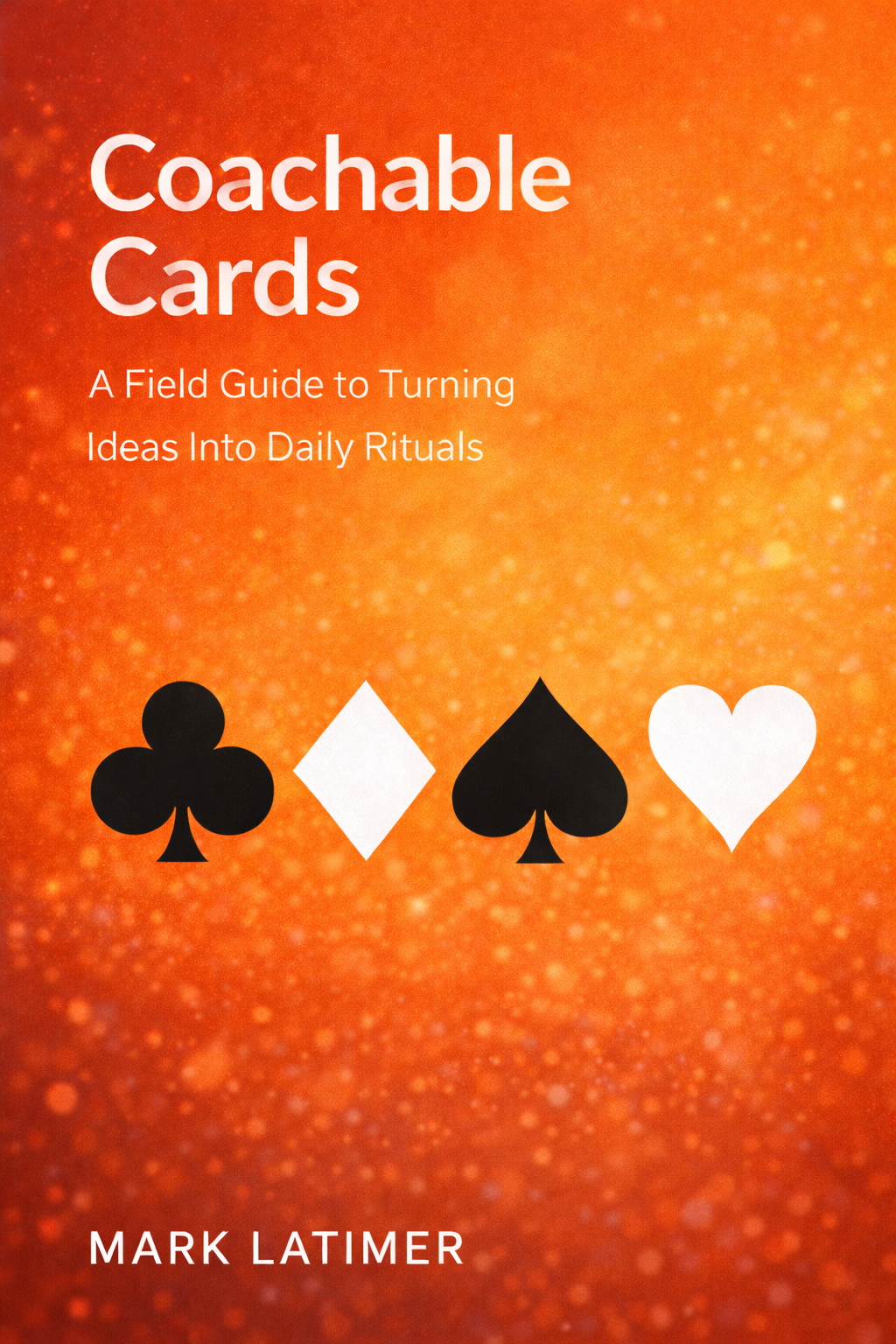
CalnFlow Library
A Field Guide to Turning Ideas into Daily Rituals
Author and systems architect
Creator of Coachable Cards and CalnFlow Reader.
CalnFlow Library
A Field Guide to Turning Ideas into Daily Rituals
A practical field guide for turning questions into daily leadership practice.
CalnFlow Library
A Field Guide to Turning Ideas into Daily Rituals
Author and systems architect
Creator of Coachable Cards and CalnFlow Reader.
CALNFLOW READER
A Field Guide to Turning Ideas into Daily Rituals
**A Field Guide to Turning Ideas into Daily Rituals**
**by Mark Latimer**
---
Introduction
Ideas change lives only when they become practice.
Most leadership systems fail at the same point: the gap between insight and action. Leaders read, agree, and return to the calendar unchanged. The problem is not motivation. The problem is translation. Insight is abstract. Daily life is concrete. What bridges the gap is ritual.
Coachable Cards is that bridge.
This field guide introduces a practical medium for leadership and reflection: cards. Not as a gimmick, but as a disciplined interface. A card is a single question, a single choice, a single moment of clarity. It is portable, repeatable, and human.
This is why cards work. They reduce complexity into an action you can take today. They turn thinking into a daily practice. They make clarity visible and accessible, not just admired.
Who This Guide Is For
This guide is written for leaders who want their teams and organizations to live inside a shared ritual, not a shared slide deck. It is for executives who want practices that travel across cultures and time zones. It is for builders who want systems that last beyond a keynote.
You might be a CEO introducing reflection into a fast-moving company. You might be a coach seeking a structure that creates breakthrough without burnout. You might be a team lead who knows that culture is built in small moments, not annual offsites. You might be an entrepreneur who wants clarity to compound without another productivity system to maintain.
Whatever your role, the common thread is this: you have experienced the gap between knowing and doing, and you want a bridge that lasts.
What You Will Find Here
The structure follows three movements:
- Part I: The Philosophy. Why cards are the right medium for clarity and leadership. Twelve chapters that establish the foundation: what a card is, why questions matter, how ritual beats willpower, and why reflection is active inquiry rather than passive thinking. You will understand the design principles behind cards and how they create belonging, integrate with the reader, and scale across enterprise environments.
- Part II: The Practice. How ritual turns insight into behavior. Twelve chapters of concrete rituals: the one card ritual, the three card reset, the team circle, the coaching session, the keynote experience. Daily habits, weekly rhythms, monthly retreats, and the 108 day challenge. Each chapter gives you a specific practice you can implement immediately, with variations for solo use, teams, and organizations.
- Part III: The Platform. How the reader and the product complete the loop. Twelve chapters on building, publishing, and scaling: Reader.c.cards as your knowledge base, building your own app, publishing your deck, licensing your system. Speaking with cards, coaching with cards, enterprise adoption, community building, and the India playbook. This is where the field guide becomes your operating system.
How to Use This Guide
Read it once for orientation. Return to it as a reference. Use the reader to search by topic when you need a specific practice. The guide is designed to be used, not consumed. Some leaders read one chapter daily with morning coffee. Some search for specific rituals before meetings. Some return to the philosophy chapters when designing their own deck. Use it the way that serves you. The structure supports multiple entry points.
This is not a coaching manual. It is an operating guide for calm, consistent practice. The reader is where the ideas live. The cards are where they become real. The rituals are what make them stick. The distinction matters. A manual tells you what to do. A guide gives you the structure to figure it out. This guide assumes you have judgment. It gives you frameworks. You apply them.
If you want a leadership system that is simple enough to keep and strong enough to compound, this field guide is your entry point. Simplicity is the design constraint. One card. Two minutes. One ritual at a time. The complexity compounds through consistency, not through added features. Start small. Stay small. Let the practice grow.
Let us begin.
A card is the smallest complete unit of clarity.
It is a single prompt that creates a decision. It is a focused question that guides attention. It is small enough to carry and strong enough to anchor behavior.
Cards are not a metaphor. They are a medium.
The Power of a Single Prompt
Leadership often fails under the weight of too much information. When everything is relevant, nothing is actionable. Cards reduce the field. They give you one question to answer now.
That is the power: one card, one question, one moment of clarity.
This is not simplification for its own sake. It is focus. It is the ability to move from complexity to decision without losing meaning. Consider a typical Monday morning: a leader faces a full inbox, competing priorities, team requests, and strategic decisions. A paragraph of advice offers options. A card offers a single question: "What is the one thing that, if done today, would make everything else easier?" That question forces a choice. It creates movement. It reduces the cognitive load of "everything matters" to "one thing matters now."
Why a Card Works Where a Paragraph Fails
A paragraph can be debated. A card cannot. A paragraph invites interpretation. A card invites action. A paragraph says "here are several ways to think about this." A card says "answer this now." The difference is decisive.
Cards are visual, portable, and repeatable. They fit into the rhythm of real life. They can be used in a meeting, a hallway, a morning routine, or a team reset. They create a shared language without the overhead of training. A team that draws cards together develops a vocabulary. "What did your card say?" becomes shorthand. The question itself becomes the culture.
A card is a leadership interface. Like a well-designed dashboard, it surfaces what matters and hides what does not. The card does not explain. It prompts. That restraint is its power.
The Enterprise Advantage
Enterprise systems need to scale across people, cultures, and roles. Cards do this naturally. A card is easy to translate. A card is easy to remember. A card is easy to repeat. When a multinational team uses the same deck, they share a practice even when they speak different languages. The question translates. The reflection translates. The ritual translates.
This is why cards work in India and globally. They respect time, honor attention, and fit into the way people already operate. In cultures where relationship and reflection are valued, cards provide structure without imposing Western productivity frameworks. They create clarity without demanding more hours.
Cards are not a shortcut. They are a disciplined medium for clarity. The discipline is in the constraint. One card. One question. One moment. That constraint creates the focus. Remove it and you get another productivity system. Keep it and you get clarity.
The question you ask determines the direction you take.
Most leaders ask questions unconsciously. The default questions are often reactive: "What is urgent?" "What is broken?" "What can we ship today?" These are necessary, but they are not sufficient. They optimize for response, not reflection. They move you through the day without moving you toward clarity.
A card is a deliberate question. It interrupts default thinking and creates new movement. It shifts you from reactive mode to reflective mode. That shift, repeated daily, changes how you lead.
The Difference Between a Question and a Decision
A good question does not just gather information. It changes behavior. It forces a choice. It brings clarity to the surface. A bad question invites more thinking. A good question invites action. "What should I do about this?" keeps you in analysis. "What is the one thing I am avoiding?" pushes you toward decision.
Cards are designed to do exactly that. They do not explain. They prompt. They are not lessons. They are triggers. Each card is a question engineered to create a specific kind of reflection: identity, clarity, energy, relationship, decision. The design is intentional. The outcome is predictable.
When you ask a different question, you create a different outcome. This is not philosophy. It is mechanics. Your brain responds to the question it receives. Change the question, change the response.
The Role of Ritual
A question asked once is a moment. A question asked in rhythm becomes a ritual. Rituals are what transform culture. A team that starts every meeting with "What is our one clarity today?" begins to think in terms of clarity. A leader who draws a card every morning begins to lead from reflection. The questions compound.
This is why cards are powerful in leadership environments. They create a shared cadence of better questions. Over time, the organization begins to think differently. Not because of a new policy, but because of a new rhythm. The rhythm is the change.
The Calm of a Clear Question
In high-pressure environments, clarity is a relief. A well-designed question creates calm. It narrows the field. It makes the next step visible. When everything feels urgent, a card that asks "What would calm look like here?" creates a pause. When you are scattered, a card that asks "What is the thread?" creates focus.
That is the core promise of cards: calm clarity, on demand. In a world of infinite inputs, the ability to narrow the field in sixty seconds is a superpower. Cards deliver that. They are the antidote to overwhelm. They are the interface for focus. They are the practice that creates the calm.
Willpower is inconsistent. Ritual is reliable.
Most leadership change efforts rely on motivation. Motivation fades. Ritual remains. You have seen it: the post-keynote high that disappears by Tuesday, the New Year resolution abandoned by February, the "we should do this more often" that never becomes often. The failure is not personal. It is structural. Motivation is a resource that depletes. Ritual is a structure that sustains.
A ritual is a small, repeatable action tied to a clear purpose. It does not require a surge of will. It requires a rhythm. That is why it works. When the cue appears, the practice follows. You do not decide each time. You have already decided. The ritual holds the decision for you.
The Architecture of Ritual
Rituals succeed because they have:
Cards provide the practice. The ritual provides the rhythm. The cue can be anything you choose. The reward comes from the clarity the card creates. The system is complete.
From Insight to Practice
Insight without ritual is intellectual. Ritual turns insight into behavior. That is how change actually happens. You can read a hundred books on leadership and remain unchanged. One ritual, performed daily for thirty days, will change you. The difference is not the quality of the insight. It is the presence of the practice.
This is why Coachable Cards is not a content system. It is a practice system. It exists to make the right behavior repeatable. The reader holds the ideas. The cards make them actionable. The ritual makes them automatic.
Enterprise Safety
Rituals are safe because they are small. They do not require organizational overhaul. They can be adopted by a single leader or a single team, and then scaled. No budget approval. No change management program. No consultant. One person draws a card at the start of their day. Others notice. They ask. They try. The practice spreads through curiosity, not mandate.
This makes enterprise adoption natural. The system is low-risk, high-trust, and immediately usable. A team can pilot cards for one sprint. A leader can test the one card ritual for one week. The commitment is minimal. The upside is real.
Ritual beats willpower because it removes friction. It makes the next action obvious.
Small practices compound into large change.
Most leadership systems fail because they require too much. They ask for transformation when what is needed is consistency. They demand hours of training, days of workshops, months of implementation. Small practices succeed because they are sustainable. Two minutes daily beats two hours monthly. Consistency beats intensity.
The Compound Effect
A single card drawn once is a moment. A single card drawn daily becomes a practice. A practice repeated becomes a ritual. A ritual maintained becomes culture. Each step builds on the last. The moment does not create change. The accumulation does.
This is not theory. This is mathematics. Small actions, repeated consistently, create exponential results over time. One percent improvement daily compounds to thirty-seven percent improvement annually. The same applies to clarity, focus, and leadership presence. The cards create the one percent. The ritual creates the consistency. The compound effect does the rest.
The Power of Starting Small
Enterprise adoption fails when the entry point is too high. Cards succeed because the entry point is one question. One card. One moment. A skeptical executive can try cards without committing to a program. A busy team can add a two-minute ritual without rearranging the calendar. The low barrier is strategic. It allows the practice to prove itself before demanding investment.
This makes adoption natural. A leader can start alone. A team can start with one ritual. An organization can scale from there. The growth is organic. It spreads because it works, not because it is mandated.
The Discipline of Small
Small does not mean trivial. Small means focused. A well-designed card contains a complete thought. It is small enough to remember and strong enough to change behavior. "What would you do if you were not afraid?" is eleven words. It can redirect a career. "What is the one thing you are avoiding?" is nine words. It can unlock a bottleneck. The power is in the precision, not the length.
This is the discipline: one card, one question, one action. Repeat. Resist the urge to add more. More cards dilute focus. More questions create overwhelm. The discipline is in the constraint.
Small practices are the foundation of lasting change. Every transformation you have witnessed began with a small commitment. Every culture shift began with one person changing one behavior. Every breakthrough began with a single question. The card is that question. The ritual is that behavior. The change is that transformation. Start small. Stay consistent. Let it compound.
Reflection is not passive. It is active inquiry.
Most leaders confuse reflection with thinking. Thinking can be circular. It can loop without resolution. "What should I do?" leads to "It depends" leads to "I need more information" leads back to "What should I do?" Reflection creates movement. It has a destination. It produces an answer, a decision, or a next step. Cards are designed for reflection, not thinking.
The Science of Reflection
Research shows that structured reflection improves decision-making. It reduces bias. It increases self-awareness. It creates better outcomes. Leaders who reflect before deciding make fewer reactive choices. Teams that reflect together develop shared understanding. The mechanism is simple: reflection creates distance from the immediate. It allows the prefrontal cortex to engage when the amygdala would prefer to react. Cards provide that structure. They frame the reflection. They guide the inquiry. They create the pause that enables clarity.
The Difference Between Thinking and Reflecting
Thinking is internal dialogue. Reflection is structured inquiry. A card creates structure. It asks a specific question. It demands a specific response. You cannot reflect on "leadership" in the abstract. You can reflect on "What is one thing you would do differently if you led without fear?" The specificity forces engagement. It moves you from vagueness to clarity.
This is why cards work in coaching. They interrupt default thinking. They create new patterns. They enable breakthrough. A client stuck in "I should be better at delegation" receives a card: "What is the one conversation you are avoiding?" The question reframes the problem. The reflection produces action. The coaching moves forward.
The Ritual of Reflection
Reflection becomes powerful when it becomes ritual. A card drawn daily creates a reflection ritual. Over time, this ritual changes how you see yourself and your work. You begin to notice patterns. You catch yourself before reacting. You make decisions from clarity rather than pressure. The ritual builds the muscle.
This is the science: structured reflection, repeated consistently, creates measurable improvement in leadership effectiveness.
Reflection is not optional. It is essential. Cards make it practical. Leaders who skip reflection make reactive decisions. Teams that skip reflection repeat the same patterns. Organizations that skip reflection drift. The cost of skipping is invisible until it is enormous. Cards make reflection doable. Two minutes. One question. Daily. The barrier could not be lower. The payoff could not be higher.
Belonging is not a feeling. It is a practice.
Most organizations struggle with belonging because they treat it as an outcome. They measure it with surveys. They try to create it with events. Belonging is actually a process. It is built through repeated shared action. Cards create that process.
The Architecture of Belonging
Belonging requires three things: shared language, shared practice, shared purpose. Cards provide all three. Without shared language, people talk past each other. Without shared practice, connection is episodic. Without shared purpose, alignment is fragile. Cards deliver all three in a single ritual.
A card creates shared language. The question becomes common vocabulary. "What did your card say?" becomes a way teams check in. "I drew the clarity card" communicates more than a paragraph. The practice becomes shared rhythm. When everyone draws at the start of the meeting, the rhythm creates cohesion. The purpose becomes visible in action. Belonging is demonstrated when people show up for the practice together.
The Card Circle
The most powerful belonging practice is the card circle. A group draws cards together. They reflect together. They create shared understanding. One person shares their reflection. Others listen without fixing. The next person shares. The circle continues. No advice. No debate. Just reflection and witness.
This is not team building. This is team practice. It creates belonging through action, not through discussion. You do not talk about trust. You build it by being vulnerable together. You do not talk about psychological safety. You create it by holding space for each other's reflections.
Enterprise Belonging
In large organizations, belonging is difficult because scale creates distance. Cards bridge that distance. They create connection across teams, cultures, and time zones. A distributed team that draws cards at the start of each sync builds a different kind of connection than a team that jumps straight to agenda items. The two minutes of reflection create a human moment before the work begins.
A card drawn in Mumbai creates the same reflection as a card drawn in New York. The practice is universal. The belonging is real. The question transcends geography. The ritual creates connection despite distance.
Designing for belonging means creating practices that connect people through shared action. Cards do that. Belonging is not a feeling you create through speeches. It is a practice you build through ritual. The team circle is that ritual. The card is the prompt. The shared reflection is the belonging. Design the practice. The feeling follows.
The reader is where ideas live.
Most leadership content lives in books that are read once and forgotten. The reader changes that. It makes ideas accessible, searchable, and actionable. You do not have to remember which chapter contained the three card reset. You search. You find. You use. The knowledge is always available.
The Reader Experience
The reader is not a book. It is a system. It organizes content by theme. It connects ideas across chapters. It makes the field guide usable, not just readable. A book sits on a shelf. A reader sits in your practice. You return to it when you need a ritual, when you are designing a deck, when you want to deepen your understanding of belonging or ritual or reflection.
This is the difference: a book is consumed. A reader is used. The reader becomes part of your daily practice. You might read one chapter with your morning coffee. You might search for "team circle" before a meeting. You might revisit the 108 day challenge when you need a structure for commitment. The reader adapts to your needs.
Search and Discovery
The reader enables search. You can find ideas by topic, by chapter, by theme. This makes the field guide a reference tool, not just a one-time read. When a team lead asks "How do we create belonging in a distributed team?" the answer is in the reader. When a coach asks "What is the structure for a card-based session?" the answer is in the reader. The reader is your knowledge base.
This is enterprise value: ideas become findable. Knowledge becomes accessible. Practice becomes systematic. Organizations that adopt cards can point their people to the reader. New hires can onboard themselves. Existing leaders can deepen their practice. The reader scales knowledge without scaling headcount.
The Reading Ritual
The reader supports ritual. You can read one chapter daily. You can search for specific practices. You can return to ideas as needed. Some leaders read one chapter each morning before opening email. Some teams read a chapter together at the start of a retreat. The reader fits the rhythm you choose.
This creates continuity. The field guide does not end when you finish reading. It becomes part of your ongoing practice.
The reader transforms ideas into a living system. A book is read and shelved. The reader is consulted and returned to. That difference is structural. The reader is built for reuse. It is built for search. It is built for the moment when you need the team circle protocol or the three card reset structure. The ideas stay alive because the system makes them accessible. That is the reader's job.
The app is where practice becomes real.
The reader creates clarity. The app creates action. Together, they complete the loop from insight to behavior. You can understand cards intellectually by reading. You understand them viscerally by drawing. The app is where the drawing happens.
The App as Companion
The app is not a replacement for the reader. It is a companion. It takes the ideas from the reader and makes them actionable. The reader answers "what" and "why." The app answers "now." You read in the reader. You practice in the app. This separation is intentional. It creates focus. Reading and doing are different modes. Mixing them dilutes both. The reader is for learning. The app is for practicing.
The Practice Interface
The app is designed for practice, not consumption. It is simple. It is fast. It is focused on one thing: drawing cards and creating rituals. Open the app. Draw a card. Reflect. Close the app. The experience should take under two minutes. There are no feeds to scroll, no notifications to manage, no features to explore. The app has one job: deliver the card and get out of the way.
This simplicity is the design. The app does not compete for attention. It supports practice. In a world of infinite distraction, the app is an island of focus. You open it with intention. You close it with clarity.
The Sync Between Reader and App
The reader and app work together. Ideas flow from reader to app. Practice flows from app to life. This creates a complete system. You learn a ritual in the reader. You perform it in the app. You live it in the world. The reader teaches the team circle. The app delivers the cards for the circle. The team performs the circle in the meeting room. The loop is complete.
The reader is where you learn. The app is where you practice. Together, they create lasting change.
The app completes the field guide. It turns reading into doing. Without the app, the reader is incomplete. You learn but you do not practice. With the app, the loop closes. You learn in the reader. You practice in the app. You live the change. The app is the bridge between insight and behavior. It is where the field guide becomes action. It is where the promise becomes real.
Keynotes inspire. Cards sustain.
Most keynotes create a moment of clarity that fades within days. The audience leaves energized. By Tuesday, the energy has dissipated. By Friday, it is gone. The keynote loop changes that. It connects inspiration to practice. The keynote creates the spark. The cards create the fuel. The practice creates the fire that lasts.
The Keynote Experience
A keynote with cards is different. The speaker uses cards. The audience engages with cards. The moment becomes a practice. Instead of passive listening, the audience draws. Instead of taking notes they will never review, they reflect. Instead of leaving with a handout, they leave with a ritual they can start tomorrow. The keynote becomes participatory. The clarity becomes personal.
This is the loop: keynote creates inspiration, cards create practice, practice creates change.
The Post-Keynote Practice
After the keynote, the cards remain. The audience can continue the practice. They can draw cards daily. They can create rituals. The speaker can share a deck link. The audience can install the app. The practice that began on stage continues at home. This extends the keynote impact. The inspiration becomes sustainable. The clarity becomes practice. The speaker's message lives beyond the event.
The Speaker's Advantage
For speakers, cards create differentiation. They offer something beyond inspiration: a practical system that audiences can use immediately. Most keynotes end with "here is what you should do." Cards end with "here is how you will do it." The audience leaves with a tool, not just an idea. They can start the next morning. They can share with their teams. The speaker becomes associated with actionable transformation, not just memorable stories.
This creates value. The keynote becomes a beginning, not an ending.
The keynote loop transforms one-time events into ongoing practice. Most speakers measure success by applause. Card-using speakers measure success by practice. Did the audience install the app? Are they drawing daily? Did the keynote create a habit? That is the metric. The keynote that creates a practice outlasts the keynote that only creates a moment. Build for the practice. The moment will follow.
Coaching creates change. Cards create structure.
Most coaching relies on conversation. That works. But conversation can meander. It can avoid the hard questions. It can recycle the same patterns. Cards add structure. They create focus. They enable breakthrough. A card interrupts the usual script. It introduces a question the client might not have asked. It creates a frame that conversation can build within.
The Coaching Session
A coaching session with cards is different. The card frames the conversation. It creates the inquiry. It guides the reflection. Open with a draw. "What card did you get? What does it ask of you?" The client reflects. The coach listens. The conversation deepens from there. Or use a card when the session stalls. "Let us draw. What question wants to be asked?" The card rescues the session from circular discussion. It creates a new entry point.
This structure is powerful. It makes coaching more effective. It creates clearer outcomes.
The Card as Catalyst
A card can interrupt patterns. It can create new perspectives. It can enable insights that conversation alone might miss. A client stuck in "I need to be more strategic" might never surface the underlying fear. A card asking "What would you do if you knew you could not fail?" might unlock it. The card bypasses the defended narrative. It creates an alternate path to insight.
This is the coaching advantage: cards create moments of clarity that conversation builds upon.
The Coaching Practice
Coaches can use cards in multiple ways: one-on-one sessions, group coaching, team facilitation. The card adapts to the context. In one-on-one, it might open the session or rescue a stuck moment. In group coaching, each person might draw and share. In team facilitation, the whole group might draw and reflect together. The card is versatile. The structure is consistent.
This flexibility makes cards valuable for coaches. They become a tool that scales across contexts.
The coaching loop creates sustainable change through structured practice. Coaching without structure relies on the coach's intuition. That works. But it does not scale. Cards add structure. The structure is repeatable. Any coach can use it. Any client can benefit. The card creates the frame. The coach creates the depth. Together, they create change that lasts beyond the session. The client leaves with a card, a reflection, and an action. That is the handoff. That is how change extends.
Enterprise adoption requires systems, not inspiration.
Most leadership programs fail at enterprise scale because they rely on individual motivation. A few champions embrace the program. The rest comply or ignore. When the champions leave, the program dies. Cards create systems that scale. The system does not depend on any single person. The ritual is the system. As long as the ritual runs, the practice continues.
The Enterprise Challenge
Enterprises need practices that work across teams, cultures, and time zones. Cards do that. They are simple enough to adopt and strong enough to create change. A card works in Bangalore and Boston. It works in engineering and sales. It works in a startup and a Fortune 500. The question translates. The reflection translates. The ritual translates.
This is the enterprise advantage: cards create consistency without requiring uniformity. Every team does not need the same deck. Every leader does not need the same ritual. But every team can use cards. Every leader can create a ritual. The consistency is in the practice, not the particulars.
The Adoption Path
Enterprise adoption starts small. One leader. One team. One practice. Then it scales. Do not start with an enterprise-wide rollout. Start with a pilot. One department. One month. Measure engagement. Measure outcomes. Let the practice prove itself. Then expand. The organic spread is more sustainable than the mandated launch.
Cards support this path. They can be adopted incrementally. They can be customized for context. They can be integrated into existing systems. Add cards to the standing meeting agenda. Add a card draw to the one-on-one template. Add a card circle to the quarterly retreat. The integration is additive. It does not require replacing what works.
The Enterprise System
Cards become an enterprise system when they are integrated into daily operations: team meetings, one-on-ones, retreats, reviews. When "we start with a card" becomes the default, cards have become systemic. When new hires are introduced to the practice in onboarding, cards have scaled. When the practice appears in the leadership development curriculum, cards have arrived.
This integration is the key. Cards become part of how the organization operates, not an add-on program.
The enterprise loop creates organizational change through systematic practice. Enterprise change fails when it is top-down mandate. It succeeds when it is bottom-up adoption. Cards enable the latter. One leader starts. One team follows. The practice spreads through proof, not policy. The enterprise that adopts cards organically has a different culture than the enterprise that imposes them. The former builds trust. The latter builds compliance. Cards work with the grain of trust. Start with invitation. Scale through evidence. The enterprise loop runs on proof.
Ritual is the operating system for leadership.
Most leadership is reactive. The calendar dictates the day. The inbox dictates the priorities. The latest crisis dictates the focus. Ritual makes it proactive. It creates moments that you choose. It establishes rhythms that persist regardless of circumstance. Cards are the interface for ritual. They are the user experience of a proactive leadership practice.
The CalnFlow Ritual Thesis
Ritual beats willpower. Ritual beats motivation. Ritual beats inspiration. Ritual is what creates lasting change. Willpower depletes. Motivation fluctuates. Inspiration fades. Ritual remains. It is a structure that runs regardless of how you feel. You do not need to feel like drawing a card. You need a cue and a commitment. The ritual does the rest.
Cards make ritual practical. They provide the structure. They create the rhythm. They enable the practice. Without cards, ritual is abstract. With cards, ritual is concrete. Draw. Reflect. Act. Repeat.
The Three Loops
The field guide creates three loops: the keynote loop, the coaching loop, the enterprise loop. Each loop connects inspiration to practice. The keynote creates the spark. The coaching deepens the practice. The enterprise scales the system. A speaker can use cards in keynotes. A coach can use cards in sessions. An enterprise can adopt cards organization-wide. The same medium serves all three.
These loops are not separate. They reinforce each other. A keynote audience member might become a coaching client. A coaching client might introduce cards to their organization. An enterprise might bring in a speaker who uses cards. The loops feed each other. Together, they create a complete system.
The Ritual System
Cards are not the ritual. They are the interface. The ritual is what you create with cards. It is the daily practice. It is the weekly rhythm. It is the ongoing commitment. The card is the prompt. The ritual is the habit. The outcome is the change.
This is the thesis: ritual is the operating system. Cards are the interface. Practice is the outcome.
The CalnFlow Ritual Thesis: ritual turns insight into behavior. Cards make ritual practical.
The one card ritual is the foundation.
Start with one card. Draw it daily. Reflect on it. Act on it. This is the simplest practice and the most powerful. Every other ritual in this guide builds on this one. Master it first.
The Daily Draw
Each morning, draw one card. Read the question. Sit with it. Let it guide your day. The timing matters. Morning works best because it sets the frame for what follows. First coffee. First quiet moment. First card. The sequence creates the cue. Make it consistent.
This takes two minutes. It creates focus. It creates clarity. It creates intention. Two minutes is not negotiable. If you cannot give two minutes to your clarity, you are not serious about leading from clarity. The brevity is the point. It proves the practice is sustainable.
The Reflection Moment
The card is not just a question. It is an invitation to reflect. Take the time to answer it honestly. Write down your answer if needed. Speaking the answer aloud works. Writing it in a journal works. Holding it in mind works. Choose what creates engagement for you. The key is that you answer. Do not skip to the next task. The reflection is the practice.
This reflection is the practice. The card is the prompt. Your reflection is the work.
The Action Step
After reflection, identify one action. What does this card ask you to do today? Make it specific. Make it small. Make it real. "Be more present" is not an action. "Have one conversation without checking my phone" is. "Improve communication" is not an action. "Send the update I have been avoiding" is. The specificity is what creates accountability.
This action is the bridge from insight to behavior. The card creates clarity. The action creates change.
The one card ritual is where practice begins. Do it for thirty days before adding anything else. Thirty days is the minimum. It takes at least that long for the cue to trigger automatically, for the reflection to feel natural, for the action step to become part of how you plan your day. Do not add the three card reset until the one card ritual is automatic. Do not add the team circle until the one card ritual is yours. Build the foundation first. Everything else rests on it.
Three cards create a reset.
When you need clarity, draw three cards. They create perspective. They reveal patterns. They create movement. One card creates focus. Three cards create context. Use three when one is not enough.
The Three Card Structure
Draw three cards. Read them together. See how they connect. Notice what they reveal. The first card might name a theme. The second might complicate it. The third might resolve or redirect. Or they might form a sequence: past, present, future. Or identity, clarity, action. The connections are where the insight lives. Do not treat them as separate. Treat them as a system.
Three cards create a system. They show relationships. They create depth that one card cannot. One card can feel narrow. Three cards create triangulation. You see the situation from multiple angles. The pattern becomes visible.
The Reset Practice
Use three cards when you are stuck. Use them when you need perspective. Use them when you need to reset. Before a difficult decision. After a disappointing outcome. At the start of a new quarter. The three card reset is your clarity protocol. It interrupts the spiral. It creates a new frame.
This is the reset ritual: three cards, three reflections, three actions. It creates clarity from confusion.
The Team Reset
Three cards work in teams. Each person draws three cards. The group reflects together. Patterns emerge. One person's cards might echo another's. Themes might surface across the group. The shared reflection creates shared clarity. Use this at the start of a strategy session. Use it when the team is stuck. Use it to reset after conflict.
This creates shared clarity. It creates alignment. It creates movement.
The three card reset creates perspective when you need it most. Keep it in your toolkit. When a decision feels stuck, draw three. When a conflict feels intractable, draw three. When you have lost the thread, draw three. The reset is reliable. It creates a new frame. It interrupts the spiral. It gives you something to do when you do not know what to do. That is its power.
The team circle creates belonging.
Gather your team. Draw cards together. Reflect together. Create shared understanding. This is the team circle. It is the most powerful team ritual in this guide.
The Circle Structure
Sit in a circle. Each person draws a card. One person shares their reflection. Others listen. Then the next person shares. No cross-talk during shares. No advice. No "what you should do." Just reflection and witness. The listener's job is to receive, not to fix. This creates safety. People share more when they know they will not be corrected or counseled. The circle is a container, not a committee.
This structure creates safety. It creates connection. It creates belonging.
The Sharing Practice
Sharing is not about answers. It is about reflection. It is about vulnerability. It is about connection. "My card asked what I am avoiding. I realized I am avoiding the hard conversation with Sarah." That is a share. "You should just have the conversation" is not. The share opens. The witness holds. The next person shares. The circle builds. Over time, the depth increases. The first circle might be surface. The tenth circle goes deeper.
This practice builds trust. It creates psychological safety. It enables deeper work.
The Team Ritual
Make the team circle a ritual. Weekly. Monthly. As needed. The rhythm creates the belonging. Start with monthly. Add weekly if the team wants more. The key is consistency. A circle that happens when someone remembers creates less belonging than a circle that happens every Friday at ten. Put it on the calendar. Protect it.
This ritual transforms teams. It creates shared language. It creates shared practice. It creates shared purpose.
The team circle creates belonging through shared practice. The circle is deceptively simple. Sit. Draw. Share. Listen. No advice. No cross-talk. No fixing. The simplicity is the design. Complexity would dilute the safety. The circle works because the rules are clear and the container is held. The facilitator's job is to hold the container. To keep the rhythm. To protect the space. When the container holds, the sharing deepens. When the sharing deepens, the belonging grows. It is that simple. It is that powerful.
The coaching session uses cards for structure.
A coaching session with cards is different. The card creates focus. It guides inquiry. It enables breakthrough. Without a card, the session might drift. With a card, the session has an anchor. The client knows where to start. The coach knows what to build on.
The Session Structure
Begin with a card. Let it frame the session. Use it to guide questions. Use it to create reflection. "Draw a card. What did you get? What does it ask of you?" The client reflects. The coach listens for what wants to be explored. The card might be the whole session. Or it might be the doorway to something deeper. Let the client lead. The card is the invitation.
This structure is powerful. It creates clarity. It creates movement.
The Card as Catalyst
A card can interrupt patterns. It can create new perspectives. It can enable insights. When the session is stuck, draw. When the client is circling, draw. When you sense something is beneath the surface, draw. The card bypasses the conscious narrative. It introduces a question the client might not have asked. It creates an opening.
Use the card strategically. Let it create the moment of clarity that coaching builds upon.
The Coaching Practice
Cards work in one-on-one coaching. They work in group coaching. They work in team facilitation. In one-on-one, the client draws and reflects. In group, each person draws and shares. In team facilitation, the whole group draws and you facilitate a collective reflection. The card adapts to the context. The practice remains consistent.
The coaching session creates change through structured inquiry. The structure is the card. The inquiry is the coach's. The client brings the content. The card creates the frame. The coach creates the depth. Together they create the breakthrough. Do not overcomplicate it. Draw. Reflect. Explore. The card does not replace the coach. It supports the coach. It gives the session an anchor. It gives the client a takeaway. The card goes home with them. The reflection continues. The change extends beyond the hour.
The keynote experience transforms audiences.
A keynote with cards is different. The audience engages. They participate. They create their own experience. Passive listening becomes active reflection. The speaker does not just present. The audience does not just receive. Together, they create something that lasts.
The Keynote Structure
The speaker uses cards. The audience draws cards. They reflect together. They create shared experience. Build card draws into the flow. After a section on clarity, have the audience draw. After a section on leadership, have them draw again. The draws create punctuation. They turn content into practice. They give the audience something to do with what they just heard.
This structure creates engagement. It creates participation. It creates impact.
The Audience Experience
Each audience member draws cards. They reflect. They create their own insights. The keynote becomes personal. Two people might draw the same card and have completely different reflections. That is the design. The card is the prompt. The reflection is theirs. The keynote creates the container. The audience fills it with their own meaning.
This personalization is powerful. It creates ownership. It creates commitment.
The Post-Keynote Practice
After the keynote, the cards remain. The audience can continue the practice. They can create rituals. Share the deck link. Offer the app. Give them a way to keep going. The keynote is the beginning. The practice is what follows. Make the handoff explicit. "You drew cards today. You can draw tomorrow. Here is how." The audience leaves with a path, not just a memory.
This extends the impact. The keynote becomes a beginning, not an ending.
The keynote experience creates lasting change through engagement. Plan the card draws in advance. Know where they fit. Know what you will ask the audience to reflect on. The draws should feel intentional, not random. They should punctuate the content. They should create the rhythm of the talk. A keynote without draws is a lecture. A keynote with draws is a practice. Design for practice. The engagement will follow.
The daily habit creates consistency.
Make card drawing a daily habit. Same time. Same place. Same practice. This creates the rhythm that enables change. Variability is the enemy of habit. Drawing sometimes in the morning, sometimes at night, sometimes when you remember creates no habit. Consistency creates the habit. Pick one time. Defend it.
The Habit Structure
Choose a time. Morning works best. Choose a place. Make it consistent. Draw one card. Reflect. Act. The time might be with first coffee. The place might be the kitchen table. The structure might be: open app, draw, read question, reflect for sixty seconds, name one action. Lock it in. Repeat for thirty days. Do not optimize. Just repeat.
This structure creates the habit. The consistency creates the change.
The Habit Loop
Cue: the time and place. Routine: draw and reflect. Reward: clarity and focus. The cue triggers the routine without requiring decision. You do not choose to draw. The cue chooses for you. The routine is the draw and reflect. The reward is the feeling of focus that follows. That reward reinforces the loop. Over time, the habit strengthens. The resistance fades.
This loop creates the habit. Over time, it becomes automatic.
The Daily Practice
The daily habit is simple. One card. Two minutes. Consistent practice. Resist the urge to add. More cards, more time, more complexity will break the habit. The power is in the constraint. One card. Two minutes. Every day.
This simplicity is the power. It makes the habit sustainable.
The daily habit creates the foundation for lasting change. Track it if that helps. A simple checkmark per day. A streak counter. Whatever creates accountability. Some people need the streak. Some do not. Know yourself. The goal is consistency, not perfection. Missing a day is acceptable. Missing two in a row is a signal. Recommit. Reset. Start again. The habit is forgiving. It rewards return. Come back. The practice is waiting.
The weekly rhythm creates depth.
Daily cards create consistency. Weekly rhythm creates depth. Together, they create lasting change. Daily practice builds the baseline. Weekly practice builds the layers. You need both.
The Weekly Structure
One day per week, go deeper. Draw multiple cards. Reflect longer. Create a weekly ritual. Sunday evening works for many. Friday afternoon works for others. Choose a day that allows thirty minutes of uninterrupted reflection. Draw three cards. See how they connect. Reflect on the week. Plan the week ahead. Make it a ritual. Same day. Same structure. Same commitment.
This structure creates depth. It creates integration. It creates progress.
The Weekly Review
Use cards for weekly review. What did you learn? What patterns emerged? What needs attention? Review your daily draws from the week. Notice themes. Notice what repeated. Notice what shifted. Use the three card reset to frame the week ahead. What clarity do you need? What is your focus? What is the one thing that matters most?
This review creates awareness. It creates adjustment. It creates growth.
The Weekly Practice
The weekly rhythm complements the daily habit. Daily creates consistency. Weekly creates depth. Do not skip daily for weekly. Do not skip weekly for daily. They serve different purposes. Daily maintains the practice. Weekly deepens the practice.
Together, they create a complete practice.
The weekly rhythm creates depth that daily practice builds upon. The weekly review is where you integrate. Daily creates the data. Weekly creates the pattern. Without the weekly review, the daily draws are moments. With it, they become a system. You see the arc. You notice what repeats. You adjust. The weekly review is the integration point. It is where insight becomes strategy. Do not skip it.
The monthly retreat creates renewal.
Once per month, create a retreat. Use cards for reflection. Use them for planning. Use them for renewal. Daily and weekly create momentum. Monthly creates perspective. Without the retreat, you can lose the forest for the trees. The retreat restores the view.
The Retreat Structure
Set aside time. Half day works. Full day is better. Use cards to guide reflection. Use them to create clarity. Block the time. Protect it. No meetings. No email. No interruptions. This is your renewal time. Draw multiple cards. Reflect on the month. What worked? What did not? What wants to shift? Use cards to structure the reflection. End with intention for the month ahead.
This structure creates renewal. It creates perspective. It creates alignment.
The Retreat Practice
Reflect on the month. What worked? What needs change? What patterns emerged? Review your weekly reviews. Notice the arc of the month. Where did you grow? Where did you stall? What do you want to carry forward? What do you want to release? Use cards to prompt the reflection. Draw. Reflect. Plan.
Use cards to guide this reflection. They create structure. They create depth.
The Monthly Ritual
The monthly retreat becomes a ritual. It creates space for reflection. It creates space for renewal. Put it on the calendar. First Friday. Last Sunday. Whatever works. Make it non-negotiable. The monthly retreat is how you avoid burnout. It is how you maintain perspective. It is how you stay aligned with what matters.
This ritual is essential for sustained practice.
The monthly retreat creates renewal that sustains daily practice. Block it. Protect it. The monthly retreat is the first thing that gets sacrificed when life gets busy. That is when you need it most. The retreat is not a luxury. It is maintenance. You would not run a machine for thirty days without maintenance. Do not run yourself that way. The retreat restores. It creates perspective. It prevents burnout. It is essential.
The 108 day challenge creates transformation.
108 days is a sacred number. It is also a practical timeframe. It is long enough to create change. It is short enough to maintain commitment. Too short and the practice does not compound. Too long and commitment falters. 108 days is the sweet spot. It is roughly one quarter plus. It is long enough to form identity. "I am someone who draws cards daily." It is short enough to see the finish line.
The Challenge Structure
Commit to 108 days of daily card practice. Draw one card daily. Reflect. Act. Track your progress. Add weekly reviews. Add a monthly retreat. Stack the practices. The challenge is not just daily draws. It is the full system: daily, weekly, monthly, for 108 days. Track simply. A checkmark per day. A brief note per week. The tracking creates accountability. It makes the commitment visible.
This structure creates commitment. It creates accountability. It creates transformation.
The Challenge Practice
Daily cards create consistency. Weekly reviews create depth. Monthly retreats create renewal. All three, for 108 days. Do not skip. One missed day is acceptable. Two in a row means you need to recommit. The challenge is about stringing days together. The streak matters. It builds identity.
Together, over 108 days, they create transformation.
The 108 Day Outcome
After 108 days, you will have a practice. You will have clarity. You will have change. You will have evidence. You will have proven to yourself that ritual works. You will have data on what shifted. You will have a system you can rely on. The challenge does not end at day 108. It launches the next phase. You have built the foundation. Now you build the life.
This is the challenge: commit to 108 days. See what happens.
The 108 day challenge creates transformation through sustained practice. Do it with others if you can. A cohort. A partner. A team. Accountability multiplies completion. Solo is fine. Together is better. Share your progress. Share your struggles. Share your insights. The challenge creates community when done in company. It creates evidence when done with witnesses. You prove to yourself that you can sustain. You prove to others that ritual works. The proof compounds.
The upgrade path creates growth.
Start with one card. Add practices. Add rituals. Add depth. This is the upgrade path. Do not rush it. Master each level before adding the next. The path is sequential for a reason.
The Path Structure
Begin with daily cards. Add weekly reviews. Add monthly retreats. Add team circles. Add coaching sessions. The sequence matters. Daily for thirty days before adding weekly. Weekly for two months before adding monthly. Monthly for one cycle before introducing team circles. Each layer requires the previous one to be stable. Building on sand creates collapse. Building on solid practice creates mastery.
This path creates growth. It creates depth. It creates mastery.
The Upgrade Practice
Each upgrade adds value. Each upgrade creates new possibilities. Each upgrade builds on the previous. The daily habit creates the foundation. The weekly review creates the reflection muscle. The monthly retreat creates the perspective. The team circle creates the belonging. The coaching session creates the breakthrough. Each adds a dimension. Together, they create a complete practice.
This progression is natural. It creates sustainable growth.
The Mastery Path
The upgrade path leads to mastery. You become fluent in cards. You create your own practices. You teach others. Mastery is not perfection. It is fluency. You can draw a card and know what to do with it. You can facilitate a circle. You can design a ritual. You can help others start. That is mastery.
This mastery is the goal. The path is the practice.
The upgrade path creates growth through progressive practice. Patience is the discipline. Each level requires mastery before the next. Rushing creates superficiality. You will have the team circle without the one card ritual. You will have the custom deck without the daily habit. The structure will exist. The foundation will not. Build the foundation. The upgrades will land differently when the base is solid. Trust the sequence.
Designing your own deck creates ownership.
When you are ready, create your own deck. Use your questions. Use your language. Use your purpose. Start after you have practiced with existing decks. You need to know what works before you design. Thirty days of daily draws. A few team circles. Then you are ready to create.
The Deck Design
Start with your purpose. What questions matter? What clarity do you need? What practice do you want? Write down ten questions you wish someone had asked you. Write down ten questions you ask your team. Write down ten questions that create the reflection you want. The deck emerges from these. Do not design in the abstract. Design from your lived experience of what creates clarity.
These questions guide the design. They create the deck.
The Card Creation
Each card is a question. Each question creates reflection. Each reflection creates action. Test each question. Draw it. Reflect on it. Does it create movement? Does it create depth? Does it feel like your voice? A good card question is specific enough to prompt and open enough to allow. "What matters most?" is too vague. "What is the one thing you are avoiding that would create the most leverage?" is specific. Design for specificity.
Design cards that matter. Design questions that create movement.
The Custom Practice
Your deck becomes your practice. It reflects your values. It supports your growth. When you draw from your own deck, you are in conversation with yourself. The questions you designed are the questions you need. The deck is a mirror. It shows you what you have committed to.
This ownership is powerful. It creates commitment. It creates change.
Designing your own deck creates ownership of your practice. Start with questions you have been asked that changed you. Start with questions you ask others that create movement. Start with questions you wish someone had asked you earlier. Your deck emerges from your lived experience. It is not an intellectual exercise. It is a distillation of what you have learned creates clarity. The deck is your operating manual. Design it from experience. Test it through use. Refine it through feedback.
Your first custom ritual creates mastery.
Take your custom deck. Create your first ritual. Make it yours. Make it real. The deck you designed deserves a ritual you own. This is where practice becomes identity.
The Ritual Design
Choose a time. Choose a place. Choose a structure. Make it consistent. Make it yours. The time might be the same as your daily habit, but now you are drawing from your deck. The place might be the same. The structure might be: draw one card from my deck, reflect, identify one action that honors the question. Write it down. The ritual should feel like yours. Not borrowed. Designed.
This design creates the ritual. The consistency creates the practice.
The Ritual Practice
Practice your ritual. Daily. Weekly. As designed. Make it real. Do it for thirty days. Notice what shifts. Notice what the deck reveals about you. Notice how the questions you wrote begin to shape your days. The practice creates the integration. Your deck becomes part of how you operate.
This practice creates mastery. It creates ownership. It creates change.
The Mastery Moment
When your custom ritual becomes automatic, you have achieved mastery. You own the practice. You can teach it. You can say "I draw from my deck every morning" and mean it. You can lead a team circle with your deck. You can share your deck with others. Mastery is when the practice is yours to give.
This mastery is the goal. The ritual is the path.
Your first custom ritual creates mastery through ownership. The ritual should feel like yours. Not borrowed. Not adapted. Yours. The time. The place. The structure. The deck. All of it should reflect your commitment. When it does, the ritual becomes identity. "I am someone who draws from my deck every morning." That identity is the outcome. The ritual creates it. Own the ritual. The mastery follows.
Reader.c.cards is where ideas live.
The reader is the foundation. It houses the field guide. It makes ideas accessible. It creates the knowledge base. When you need to remember how the team circle works, you go to the reader. When you want to understand the philosophy behind cards, you go to the reader. When you are designing your deck and need a framework, you go to the reader. The reader is always available.
The Reader Purpose
The reader exists to make ideas findable. It organizes content. It enables search. It creates structure. You do not have to remember which chapter contained the three card reset. You search. You find. You use. The reader turns the field guide from a linear read into a reference system. That shift changes how you use it. You stop consuming and start consulting.
This purpose is essential. It makes the field guide usable.
The Reader Experience
Read chapters. Search topics. Find practices. The reader supports all of this. Read straight through for orientation. Return for specific practices. Search when you need a quick answer. The reader adapts to your needs. Use it as a daily reading ritual. Use it as a pre-meeting reference. Use it as a design resource when building your deck.
This experience is designed for use, not consumption.
The Reader Integration
The reader connects to the app. Ideas flow from reader to app. Practice flows from app to life. You learn the team circle in the reader. You get the deck in the app. You run the circle in the meeting room. The reader teaches. The app delivers. Life is where it lands. This integration creates the complete system.
Reader.c.cards is where the field guide lives and breathes.
Building your app creates your practice.
The app is where cards become real. You can build your own app. You can customize it. You can make it yours. When you have a custom deck, you need a way to deliver it. The platform enables that. Your deck. Your branding. Your audience. Your practice, scaled.
The App Building
Start with a deck. Add cards. Customize the experience. Make it yours. The deck is the foundation. Add the cards you designed. Add the questions that matter. Then customize. Colors. Imagery. Flow. The app becomes an extension of your brand. It reflects your voice. It delivers your practice.
This building creates ownership. It creates commitment.
The App Customization
Customize the design. Customize the flow. Customize the experience. The default is clean and minimal. You can make it yours. Match your brand. Match your audience. Match your aesthetic. The customization is not superficial. It signals that this is your practice, not a generic tool. Your people see your brand. They feel the alignment.
This customization makes the app yours. It creates personal connection.
The App Practice
Use your app daily. Make it part of your ritual. Make it part of your practice. If you built it, use it. Draw from your deck. Share it with your team. Run circles with it. The app you built becomes the interface for your practice. You are not using someone else's system. You are using yours.
This practice creates change. It creates mastery.
Building your app creates your own practice system.
Publishing your thinking creates influence.
When you create a deck, you can publish it. Share your questions. Share your clarity. Share your practice. Publishing transforms your deck from private practice to public resource. Others can use what you built. Your questions become their prompts. Your clarity becomes their starting point.
The Publishing Path
Create your deck. Refine it. Publish it. Share it. Do not wait for perfection. A deck that is good enough and published beats a deck that is perfect and private. Refine through use. Let feedback inform the next version. Publishing is not a destination. It is a step. Share with your network first. See what resonates. Iterate.
This path creates influence. It creates impact.
The Publishing Practice
Publishing is not about perfection. It is about sharing. Share your questions. Share your clarity. The deck does not have to be complete. It has to be useful. Twenty cards that create real reflection beat fifty cards that dilute. Publish what works. Add what emerges. The practice of publishing is itself a ritual. It forces clarity. It creates accountability.
This practice creates connection. It creates community.
The Publishing Impact
When you publish, others can use your deck. They can learn from your questions. They can create their own practice. A leader in Mumbai might use your deck with their team. A coach in London might use it with clients. Your influence extends beyond your immediate circle. Your questions travel. Your practice scales. That is publishing.
This impact is powerful. It creates movement.
Publishing your thinking creates influence through sharing.
Licensing your system creates value.
When you create a valuable deck, you can license it. Create revenue. Create impact. Create value. Licensing is the next step after publishing. Publishing shares. Licensing structures the exchange. Enterprises pay for decks that create organizational clarity. Coaches pay for decks that create client breakthrough. The license formalizes the value exchange.
The Licensing Model
License your deck for use. Set terms. Set pricing. Create value. The model can be per-seat, per-team, per-organization. It can be one-time or subscription. The key is alignment: the price should reflect the value the deck creates. A deck that transforms team meetings is worth more than a deck that creates momentary reflection. Price accordingly. Structure the terms clearly.
This model creates revenue. It creates sustainability.
The Licensing Practice
Licensing is not just about money. It is about value. It is about impact. When you license, you are saying this deck is worth paying for. That commitment elevates the deck. It elevates your practice. It creates a feedback loop: licensees expect quality, so you deliver quality. The practice of licensing sharpens the product.
This practice creates sustainability. It creates growth.
The Licensing Impact
When you license, you create value for yourself and others. You create a system that compounds. Revenue enables you to invest in better decks. Better decks create more value. More value creates more licenses. The cycle builds. Your practice becomes a business. Your clarity becomes a product.
This impact is powerful. It creates opportunity.
Licensing your system creates value through structure.
Speaking with cards creates differentiation.
When you speak, use cards. Engage your audience. Create participation. Create impact. Most keynotes are one-way. You speak. They listen. They leave inspired. They forget. Cards change the equation. You speak. They draw. They reflect. They leave with a practice. The differentiation is immediate.
The Speaking Practice
Use cards in your talks. Engage the audience. Create participation. Create experience. Build card draws into the flow. After each major section, have the audience draw. "We have been talking about clarity. Draw a card. What does it ask of you?" The draw creates a punctuation. It turns content into practice. It gives the audience something to do. They become participants, not spectators.
This practice creates differentiation. It creates impact.
The Speaking Advantage
Cards create engagement. They create participation. They create memorability. An audience that draws remembers more than an audience that only listens. An audience that reflects leaves with more than an audience that only takes notes. The advantage is measurable. Post-event surveys show higher retention. Follow-up engagement increases. The audience associates you with actionable transformation.
This advantage is powerful. It creates value.
The Speaking Impact
When you speak with cards, you create lasting impact. The audience remembers. They practice. They change. Share the deck link. Offer the app. Give them a way to continue. The keynote is the beginning. The practice is what follows. Your impact extends beyond the event. You become the speaker who gave them a system, not just a speech.
This impact is the goal. Cards are the tool.
Speaking with cards creates differentiation through engagement.
Coaching with cards creates structure.
When you coach, use cards. Create focus. Create inquiry. Create breakthrough. Coaching can meander. Conversation can circle. Cards provide structure. They create anchors. They create frames. They rescue stuck sessions.
The Coaching Practice
Use cards in coaching. Frame sessions. Guide inquiry. Create clarity. Open with a draw. "What card did you get? What does it ask of you?" Or use a card when the session stalls. "Let us draw. What question wants to be asked?" The card creates a new entry point. It bypasses the defended narrative. It creates an opening. The coach's job is to follow the opening. The card creates it.
This practice creates structure. It creates effectiveness.
The Coaching Advantage
Cards create focus. They create inquiry. They create breakthrough. A client stuck in "I need to be more strategic" might never surface the fear beneath. A card asking "What would you do if you knew you could not fail?" might unlock it. The card introduces a question the client would not have asked. It creates the moment of clarity that coaching builds upon.
This advantage is powerful. It creates value.
The Coaching Impact
When you coach with cards, you create better outcomes. Clients get clarity. They take action. They change. The structure of cards makes coaching more effective. Sessions have anchors. Progress is measurable. The client leaves with a card, a reflection, and an action. The impact extends beyond the session.
This impact is the goal. Cards are the tool.
Coaching with cards creates structure that enables breakthrough.
Enterprise with cards creates scale.
When enterprises adopt cards, they create organizational change. They create consistency. They create culture. One team using cards is a pilot. Five teams is a movement. Twenty teams is a system. Enterprise scale means cards become part of how the organization operates.
The Enterprise Practice
Adopt cards organization-wide. Create practices. Create rituals. Create change. Start with a pilot. Prove the value. Document the impact. Then expand. Add cards to onboarding. Add cards to leadership development. Add cards to team meeting templates. Add cards to retreat agendas. The integration is incremental. The adoption is organic. Mandate kills culture. Invitation builds it. Invite. Model. Scale.
This practice creates scale. It creates impact.
The Enterprise Advantage
Cards create consistency. They create shared language. They create culture. A distributed organization that uses cards has a common practice. Teams in different time zones draw from the same deck. They share a vocabulary. "What did your card say?" works in any language. The practice translates. The belonging translates. The culture becomes portable.
This advantage is powerful. It creates value.
The Enterprise Impact
When enterprises adopt cards, they create organizational change. Teams align. Culture shifts. Performance improves. The mechanism is simple: shared ritual creates shared clarity. Shared clarity creates shared action. Shared action creates results. Cards are the interface. The impact is the outcome.
This impact is the goal. Cards are the system.
Enterprise with cards creates scale through systematic practice.
Community with cards creates connection.
When communities use cards, they create belonging. They create connection. They create movement. A community is more than an audience. It is a group that practices together. Cards give communities a shared practice. They create the ritual that holds the community together.
The Community Practice
Use cards in communities. Create circles. Create rituals. Create belonging. Run virtual card circles. Run in-person circles. Create a monthly rhythm. The community gathers. Everyone draws. Everyone shares. The practice creates the connection. The ritual creates the bond. Communities that practice together stay together. Communities that only consume together drift apart.
This practice creates connection. It creates impact.
The Community Advantage
Cards create shared language. They create shared practice. They create belonging. When community members draw from the same deck, they share a vocabulary. They can reference cards. They can ask "what did you draw?" The question becomes a connector. The practice becomes a bridge. Belonging is built through shared action, not shared consumption.
This advantage is powerful. It creates value.
The Community Impact
When communities use cards, they create connection. People belong. They practice. They change. The community becomes a practice community, not just a content community. Members support each other's growth. They hold each other accountable. They create collective clarity. The impact compounds.
This impact is the goal. Cards are the medium.
Community with cards creates connection through shared practice.
The India playbook creates opportunity.
India is a massive market. Cards work in India. The playbook shows how. India has millions of leaders, millions of teams, millions of organizations seeking clarity and practice. Cards fit. The playbook documents how.
The India Opportunity
India has millions of leaders. They need clarity. They need practice. Cards provide both. The market is vast. The need is real. Leadership development in India often relies on Western models that do not fully translate. Cards offer something different. They are simple. They are portable. They respect time. They honor reflection. They create practice without demanding productivity frameworks that may not fit. The opportunity is to serve this market with a practice that works.
This opportunity is massive. It creates value.
The India Playbook
The playbook shows how to adopt cards in India. It shows practices. It shows rituals. It shows results. How to run card circles in Indian team cultures. How to integrate cards into existing leadership development. How to respect regional differences while maintaining the core practice. How to scale from pilot to organization. The playbook is practical. It is based on real deployments. It documents what works.
This playbook creates opportunity. It creates impact.
The India Practice
Cards work in India because they respect time. They honor attention. They fit culture. Indian business culture values relationship. Cards create connection through shared reflection. Indian business culture values efficiency. Cards deliver clarity in two minutes. Indian business culture spans many languages and regions. Cards translate. The question works in any language. The ritual works in any context. Cultural alignment is the key. Cards align.
This practice creates adoption. It creates change.
The India playbook creates opportunity through cultural alignment.
The next 108 days create your future.
Commit to 108 days of practice. See what happens. Create your future. The invitation is concrete. Not "someday." Not "when things calm down." The next 108 days. Starting now.
The 108 Day Commitment
Commit to daily cards. Commit to weekly reviews. Commit to monthly retreats. Commit to practice. Write it down. Tell someone. Put it on the calendar. The commitment must be visible. Visible to you. Visible to others. Accountability comes from visibility. Make the commitment real. Make it specific. "I will draw one card every morning for 108 days." "I will do a weekly review every Sunday." "I will do a monthly retreat on the first Friday." Specificity creates follow-through.
This commitment creates change. It creates future.
The 108 Day Practice
Practice daily. Review weekly. Retreat monthly. Build your system. Do not skip. One missed day is acceptable. Two in a row means recommit. The streak matters. It builds identity. "I am someone who does this." That identity is the outcome. The practice creates it. Protect the practice. Defend the time. The 108 days are an investment. Treat them as such.
This practice creates mastery. It creates change.
The 108 Day Outcome
After 108 days, you will have a practice. You will have clarity. You will have change. You will have proof. You will have demonstrated to yourself that ritual works. You will have data. You will know what shifted. You will have a system you can rely on. The 108 days do not end the practice. They launch it. You have built the foundation. Now you build the life.
This outcome is the goal. The practice is the path.
The next 108 days create your future through committed practice.
This book is a guide, not a finish line.
The invitation is to practice. You have reached the end of the field guide. The beginning of the practice is ahead.
If the first three books establish authority, this field guide establishes continuity. It turns insight into daily rhythm. It keeps clarity alive after the keynote ends. Other resources inspire. This guide operationalizes. It gives you the structure to make inspiration sustainable. That is the purpose. Not more insight. More practice.
What Happens Next
You start with one card. You turn it into one ritual. You keep it for a week. The system compounds. Then you add weekly review. Then monthly retreat. Then team circle. Then custom deck. The upgrade path is clear. The sequence is proven. The pace is yours. Do not rush. Master each level. Let the practice build.
This is the loop:
Reader -> Practice -> Coaching -> Enterprise -> Platform
The reader creates clarity. The ritual creates behavior. The behavior creates trust. The trust creates adoption. Each step enables the next. The reader teaches. The practice proves. The coaching deepens. The enterprise scales. The platform compounds. The loop is complete when it runs without you pushing. When the ritual holds the practice. When the practice holds the culture.
The Invitation
If you want a leadership system that lives beyond inspiration, accept the invitation.
Draw one card. Ask one question. Practice one ritual.
That is how the platform becomes real. Not through reading. Through doing. The field guide has given you the map. The practice is the territory. Begin.
Field Guide invitation
The Coachable Cards Field Guide completes the practice loop. The full guide opens next in the CalnFlow Reader.
Thank you for reading. Thank you for practicing.
This field guide is complete. The practice begins now. You have the philosophy. You have the practices. You have the platform. The rest is yours to build.
The Invitation
Draw one card. Ask one question. Practice one ritual. Not tomorrow. Today. The invitation is immediate. The practice does not wait for the perfect moment. The perfect moment is now. Draw. Reflect. Act. That is the entry point. Everything else builds from there.
This is the invitation. This is the beginning.
The Practice
Practice daily. Practice weekly. Practice monthly. Make it yours. Adapt the rituals to your context. Modify the practices to fit your life. The field guide is a framework. You fill it with your commitment. Your clarity. Your change. The practice becomes yours when you make it consistent. When you defend it. When you let it compound.
This practice creates change. It creates mastery.
The Future
Your future is in your practice. Your clarity is in your cards. Your change is in your commitment. The cards do not create the future. You do. The cards create the structure. The ritual creates the rhythm. The commitment creates the outcome. You have what you need. The reader. The app. The practices. The philosophy. The rest is execution.
This future is yours to create.
Thank you for reading. Thank you for practicing. Begin now.